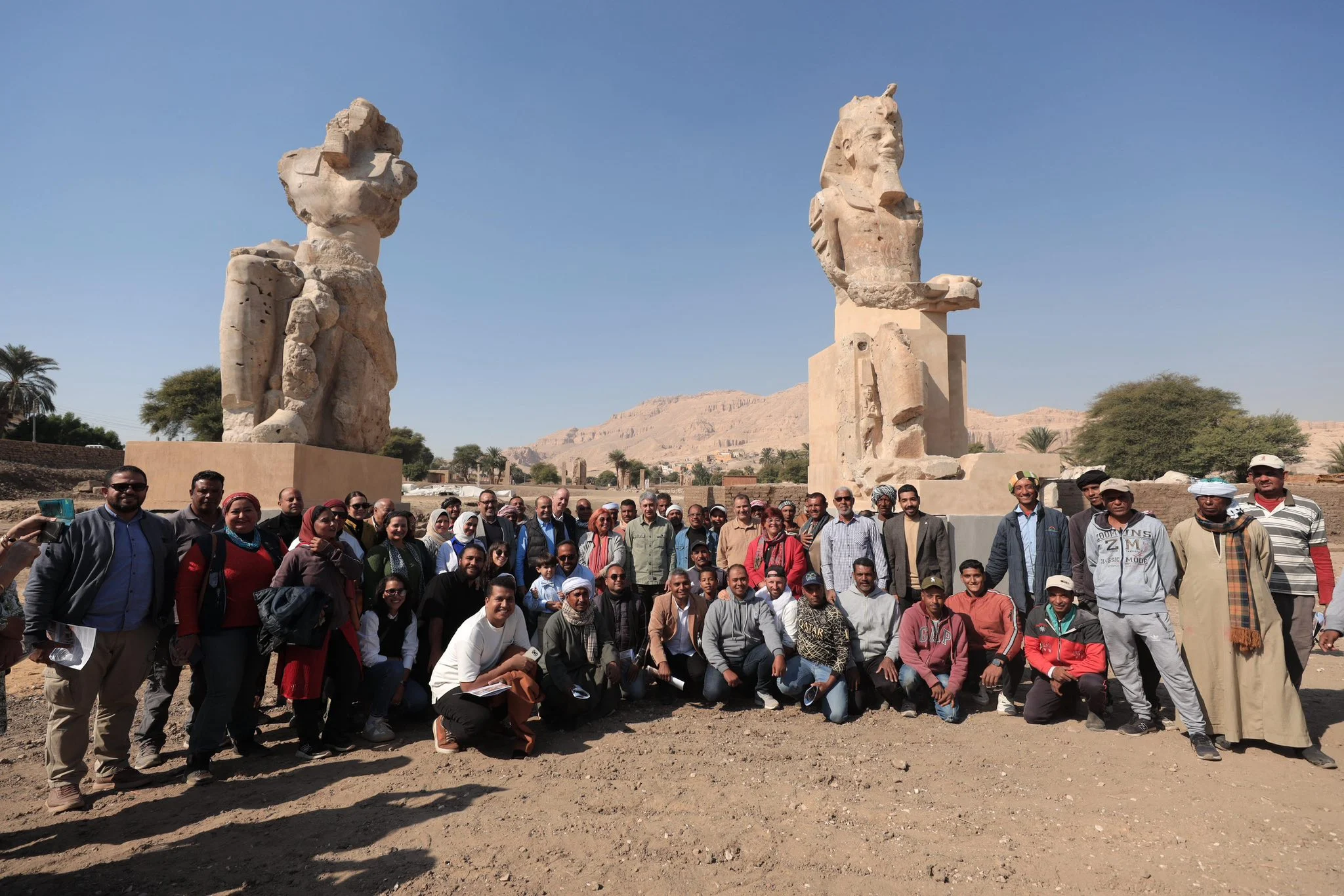
In Egypt’s ancient city of Luxor, two Colossal Statues of Amenhotep III have been officially unveiled following an extensive restoration and reassembly project that spanned nearly two decades. The completion of the work restores a sense of scale and grandeur to monuments that had lain fragmented for millennia.
The colossal statues were severely damaged by a powerful earthquake around 1200 BCE, an event that also destroyed much of Amenhotep III’s vast mortuary temple. Over time, fragments of the statues were scattered across the site, repurposed for later construction, or incorporated into other monumental complexes.
Standing 14.5 and 13.6 metres tall, the statues are carved from Egyptian alabaster and depict the pharaoh seated, facing the Nile. Each figure is accompanied by smaller sculptural representations of his wife, Queen Tiye, positioned alongside him. Their orientation and composition reflect the symbolic relationship between royal power, the river, and the afterlife in ancient Egyptian belief.
Amenhotep III ruled during one of the most prosperous periods of Ancient Egypt, from approximately 1390 to 1353 BCE. His mortuary temple once covered an area of around 35 hectares and was considered the largest of its kind in Egypt, surpassing even later temple complexes in scale.
Restoration work on the statues began in the late 1990s under the supervision of a joint Egyptian–German archaeological mission. One of the most remarkable aspects of the project lies in what it reveals about ancient construction techniques. Unlike many monolithic statues of the period, these colossi were partially assembled from separate sculptural blocks anchored to a central core, demonstrating a sophisticated understanding of structural engineering.
Restorers painstakingly returned original fragments that had been removed from the site over centuries, including blocks that had been reused in the construction of the Karnak Temple complex. By reintegrating these elements, the team was able to reconstruct the statues with a high degree of archaeological accuracy.
The restored monuments now stand on the west bank of the Nile in Luxor, near the entrance to the former mortuary temple of Amenhotep III. For visitors, the site offers not only an encounter with two of the largest surviving royal statues from ancient Egypt, but also a rare opportunity to appreciate the technical ingenuity of the craftsmen who created them more than three thousand years ago.
The unveiling marks a significant milestone in the preservation of Egypt’s cultural heritage, reaffirming Luxor’s status as one of the world’s most important open-air museums and highlighting the long-term commitment required to restore monuments of such scale and complexity.
Credit: Ministry of Tourism and Antiquities