A new name is preparing to reshape international rail travel from the Netherlands. Dutch private operator GoVolta has confirmed the launch of its first open-access international train services, introducing direct daytime connections from Amsterdam to Berlin and Hamburg starting in March 2026.
The announcement was made during a press conference in Breda on 8 December 2025, positioning GoVolta as the latest challenger in Europe’s increasingly competitive long-distance rail market. The company’s ambition is clear: make international train travel as intuitive, affordable, and habitual as flying.
First departures set for March 2026
GoVolta’s inaugural service will depart from Amsterdam Centraal to Berlin on 19 March 2026. A day later, on 20 March, the operator will launch its second route linking Amsterdam with Hamburg.
Both routes will operate as same-day return services, with trains departing Amsterdam in the morning and returning the same day. Initially, each route will run three times per week.
The Amsterdam–Berlin service will operate on Tuesdays, Thursdays, and Sundays. The Amsterdam–Hamburg route will run on Mondays, Wednesdays, and Fridays. GoVolta plans to increase both routes to daily services at a point to be determined during summer 2026.
Routes and intermediate stops
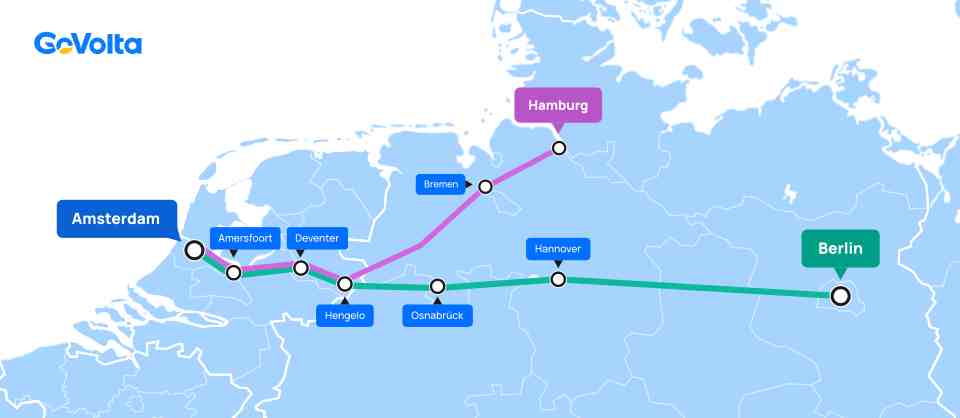
The Amsterdam–Hamburg service will call at Amersfoort Centraal, Deventer, and Hengelo before crossing into Germany at Bad Bentheim. The final stretch includes a stop at Bremen Hauptbahnhof, with Hamburg-Harburg as the terminus.
The Amsterdam–Berlin trains will follow a similar path through Amersfoort, Deventer, Hengelo, and Bad Bentheim, continuing via Osnabrück Hauptbahnhof and Hannover Hauptbahnhof before terminating at Berlin Gesundbrunnen. From summer 2026, the Berlin terminus is expected to move to Berlin Spandau.
These routes deliberately avoid high-speed lines, focusing instead on classic mainline infrastructure to control costs and maintain operational flexibility.
Founders with night train experience
GoVolta was founded by Hessel Winkelman and Maarten Bastian, both of whom have extensive experience in international rail travel. They previously co-founded Green City Trip, a company specialising in charter night trains from the Netherlands to European cities such as Prague. That company was recently acquired by night train operator European Sleeper.
With GoVolta, the founders are shifting their focus from overnight travel to daytime services, responding to what they see as unmet demand for simple, affordable international rail journeys.
Maarten Bastian explains that many travellers would prefer to take the train, but are often pushed toward flying or driving due to high rail prices or complex booking systems. GoVolta’s aim, he says, is to remove those barriers by offering low fares, guaranteed seating, and optional city trip packages that mirror the convenience of flight-based travel.
Pricing strategy inspired by aviation
GoVolta’s pricing model borrows heavily from the airline industry. Fares start at 10 euros, with around 10 percent of seats offered at that entry price. The average fare for a full-route journey is expected to be approximately 30 euros one way.
Prices will fluctuate based on demand, similar to airline yield management. Two pieces of hand luggage are included in the base fare, while larger luggage will incur an additional fee.
During the press conference, GoVolta confirmed that ticket sales went live at the start of the event and that 452 tickets had already been sold within the first hour.
Seat selection and onboard experience
One of GoVolta’s distinguishing features is its emphasis on seat choice. Passengers can access detailed seat maps and reserve specific seating configurations, including face-to-face 2+2 arrangements.
For travellers seeking additional space or a preferred direction of travel, GoVolta offers the option to reserve adjacent seats for a small surcharge. This feature, branded as the XL Duo Seat, allows passengers to secure extra legroom and avoid sharing seating with strangers.
Onboard, the trains will include a dedicated lounge coach offering food and drinks, reinforcing the idea of rail travel as a comfortable, social experience rather than a purely functional one.
Rolling stock and capacity
GoVolta has acquired second-hand Type I10 coaches from Belgian railway operator SNCB. At launch, the fleet will consist of 11 coaches: two Comfort Class coaches with a 1+2 seating layout, eight Economy Class coaches with open-plan 2+2 seating, and one lounge coach.
In total, the trains will offer 820 seats, with 132 in Comfort Class and 688 in Economy Class. Additional rolling stock is expected to be added as services expand.
Distribution and regulatory constraints
Tickets can be purchased directly via the GoVolta website, as well as through third-party channels including Deutsche Bahn, travel agencies, and online ticket platforms. Combined train-and-hotel offers will also be available.
Dutch national rail operator NS will not sell GoVolta tickets. Within the Netherlands, GoVolta services are restricted to international passengers only. Domestic travel on GoVolta trains is prohibited under Dutch law, as cabotage rights remain reserved for NS under the Main Line Network Concession. This exclusivity is currently the subject of legal dispute at the European Court of Justice.
Expansion plans across Europe
Looking ahead, GoVolta plans to launch a third route between Amsterdam and Paris Gare du Nord in December 2026. Unlike high-speed services, this train would operate via the classic route through Belgium, with the final alignment still under consideration.
Longer-term ambitions include routes from Amsterdam to Frankfurt, Munich, Basel, Bruges, and Copenhagen. Applications to assess the economic impact of these services have already been submitted to the Dutch rail regulator, ACM.
The founders envision GoVolta evolving into a pan-European network of affordable international trains, offering a credible alternative to short-haul flights and long-distance car travel.
A name built around motion and energy
The name GoVolta reflects the company’s positioning. Volta evokes electricity, energy, and speed, referencing Alessandro Volta, inventor of the galvanic battery. Combined with Go, the brand aims to signal forward movement and modern, sustainable travel.
As Europe’s rail market continues to liberalise, GoVolta’s entry underscores a broader shift toward competition, affordability, and customer-focused innovation. Whether passengers embrace this new model at scale will become clear once the first trains roll out of Amsterdam in March 2026.