
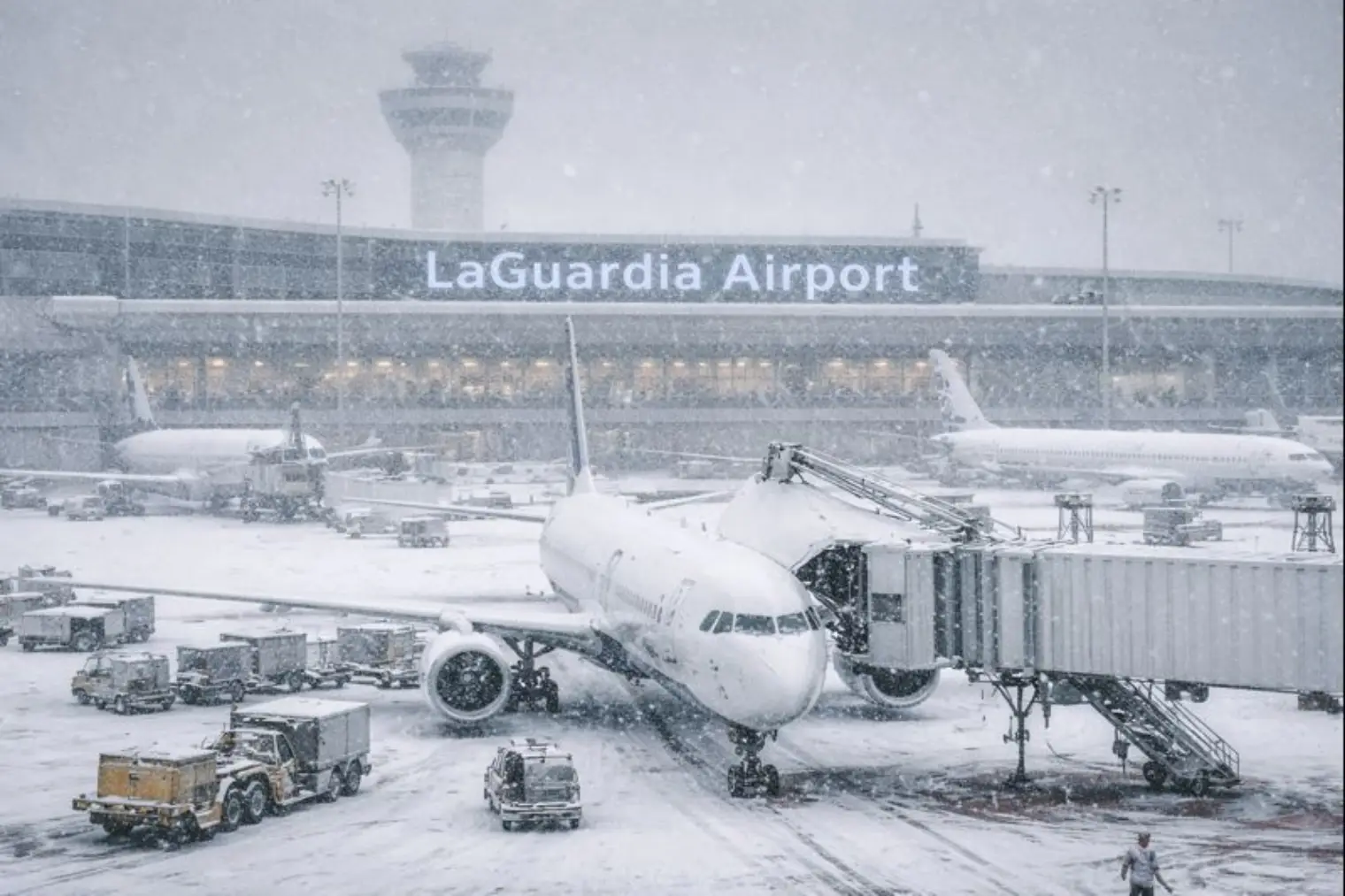
A massive winter storm sweeping across the United States on January 25–26, 2026, triggered widespread flight cancellations and severe disruptions at 13 major airports, underscoring the scale of the weather system and its impact on the national air travel network.
The storm first crippled operations in the Northeast and Mid-Atlantic before sending ripple effects through major hubs in the South and Midwest, as aircraft and crews were unable to reposition.
Northeast and Mid-Atlantic airports
Airports in the Northeast were among the hardest hit as heavy snow, sleet, and freezing rain forced airlines to ground the majority of flights.
LaGuardia Airport experienced one of the highest cancellation rates, with most departures cancelled. Nearby, John F. Kennedy International Airport also saw substantial cancellations that sharply reduced capacity across the New York metro area.
At Philadelphia International Airport, extensive cancellations left only limited operations running. Ronald Reagan Washington National Airport reported nearly a full shutdown, with airlines cancelling almost all departing flights.
Further disruption was recorded at Newark Liberty International Airport, where significant cancellations added pressure to already congested airspace. Washington Dulles International Airport also faced a high volume of cancelled flights. In New England, Boston Logan International Airport dealt with both cancellations and intermittent closures as snowfall intensified.
Major hubs across other US regions
Although the storm’s core was concentrated in the Northeast, its effects spread nationwide.
Dallas–Fort Worth International Airport experienced heavy cancellations and delays, disrupting connections across the southern and central US. Charlotte Douglas International Airport saw widespread cancellations, particularly on routes tied to the East Coast.
At Hartsfield–Jackson Atlanta International Airport, the busiest airport in the country, significant cancellations highlighted how disruptions in one region can cascade through the entire aviation system. In Florida, Orlando International Airport reported more than 400 cancelled flights as airlines adjusted schedules.
Regional impacts were also felt at Piedmont Triad International Airport and Raleigh–Durham International Airport, both of which reported numerous cancellations linked to storm-affected routes.
Nationwide ripple effects
In total, 13 airports experienced significant cancellations during the two-day storm, but the disruption extended far beyond those locations. As airlines worked to recover, delays and rolling cancellations continued nationwide, illustrating how large winter storms can quickly overwhelm the tightly connected US aviation network.