As turbulence becomes a growing challenge for global aviation, Emirates is taking a proactive, technology-driven approach to make flights smoother and safer. With turbulence incidents increasing in frequency and intensity due to climate change, the airline has implemented a multi-layered system that combines artificial intelligence, advanced weather prediction tools, and real-time data sharing across its network.
Captain Hassan Alhammadi, Divisional Senior Vice President Flight Operations at Emirates, explained that while turbulence can never be completely eliminated, new technologies are helping to significantly reduce its impact. “We recognise that turbulence remains an ongoing challenge, but we’re committed to doing everything possible to minimise unexpected severe encounters. Through partnerships with technology leaders and the use of AI, we’re already seeing validation of the benefits these systems can deliver,” he said.
Alhammadi added that Emirates’ initiatives have led to a “significant reduction in unexpected severe turbulence incidents over the past year,” making journeys safer and more comfortable for passengers and crew alike.
Multi-Layered Technology For Smoother Flights
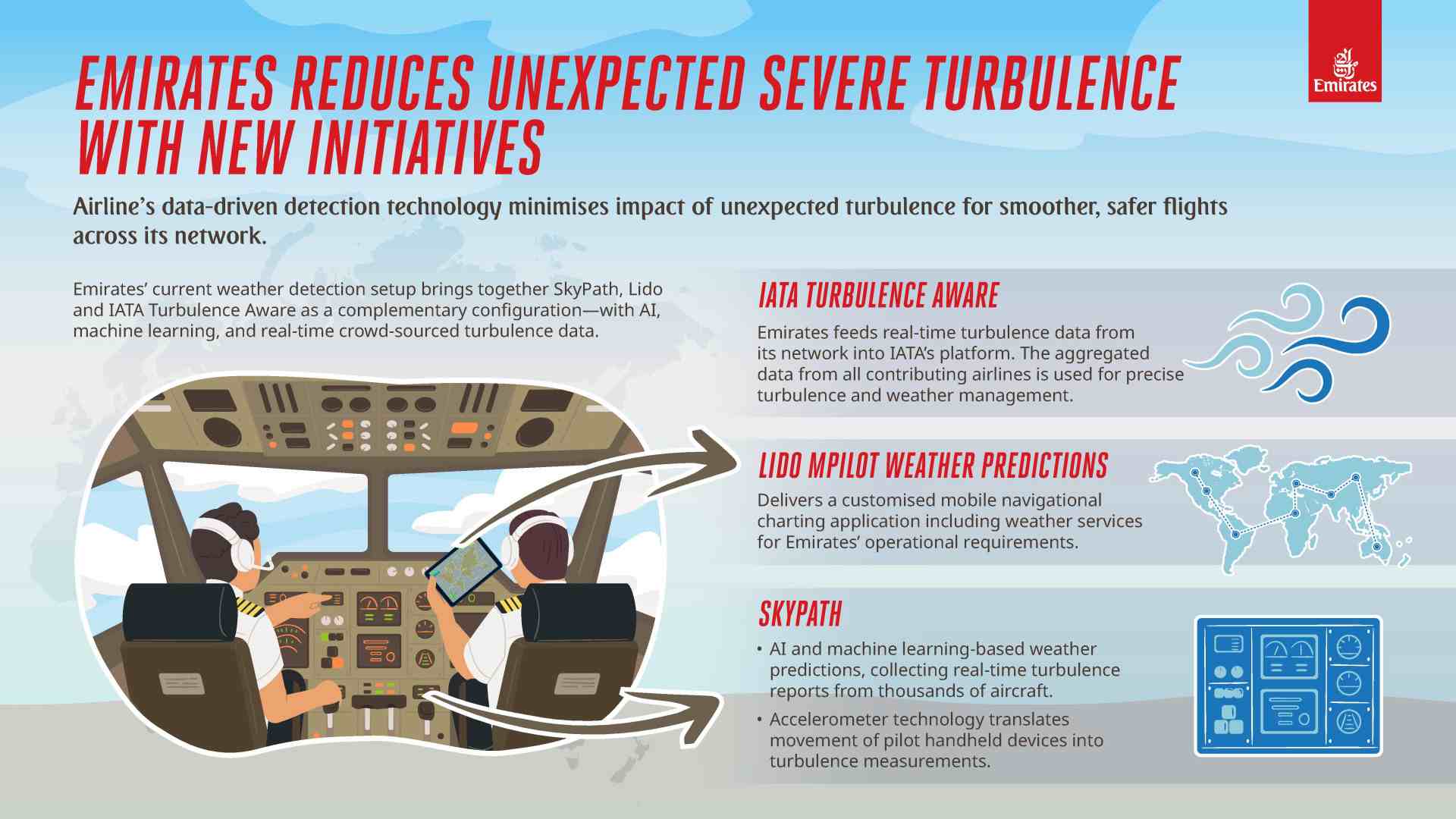
Emirates’ turbulence management strategy integrates three main systems – SkyPath, Lido mPilot, and IATA Turbulence Aware – to give pilots access to real-time turbulence data and predictive insights.
SkyPath, developed in partnership with Emirates, uses AI and machine learning to predict turbulence zones that traditional models often miss. It analyses data from thousands of aircraft and combines Eddy Dissipation Rate (EDR) measurements, ADS-B transponder signals, and iPad accelerometer readings to generate highly accurate turbulence forecasts, even in clear-air conditions.
Lido mPilot, created with Lufthansa Systems, enhances flight navigation by providing detailed weather predictions, live cloud and convection data, and turbulence and icing forecasts. The system, which sources information from the German Weather Service, gives pilots comprehensive situational awareness during flight planning and operations.
Through IATA’s Turbulence Aware Programme, Emirates shares and receives live turbulence data from airlines around the world, creating a continuously updated global map of atmospheric conditions. This real-time data is integrated into the airline’s electronic flight bag, allowing pilots to visualise turbulence patterns mid-flight and adjust routes accordingly.
A Safer, Smarter Sky
By blending predictive AI, live analytics, and global data sharing, Emirates is setting new standards for turbulence management. Pilots can now anticipate and avoid unstable airspace more effectively, improving passenger comfort, safety, and even fuel efficiency.
As part of its broader innovation strategy, Emirates plans to continue collaborating with partners and global aviation bodies to refine turbulence prediction and reporting technologies. These efforts not only enhance onboard experience but also contribute valuable insights to the wider aviation industry as it adapts to the changing dynamics of global weather.