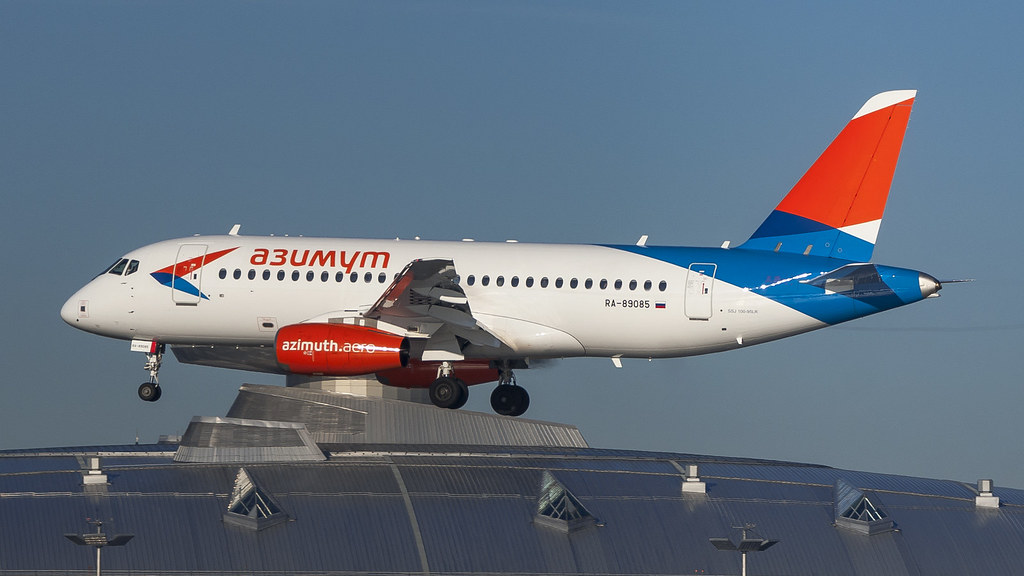
On its own, a supply squeeze would already be a serious challenge for airlines trying to keep schedules intact during the summer season. But the more revealing part of Azimut’s warning is that the crisis is no longer only about access to fuel. It is about the economics of flying in a market where supply disruption and price inflation are hitting at the same time. According to the carrier, average jet fuel prices at Russian airports have risen by 17% since the beginning of June, while in some locations the increase has been dramatically steeper. In Makhachkala, Azimut said the price of aviation kerosene surged by 64%, reaching 157,000 roubles.
The airline’s conclusion was stark. Under current conditions, it said, operating the planned flight programme is losing “all economic sense” on both domestic and international routes.
This is no longer just a supply issue – it is a profitability crisis for airlines
The most important angle in Azimut’s statement is that it reframes Russia’s jet fuel problem from a logistical disruption into a profitability crisis. Airlines can sometimes absorb higher operating costs if demand is strong enough, if routes are strategically important, or if the price shock is temporary and limited. What makes the current situation more serious is the combination of two pressures at once: airlines are being told there may not be enough fuel available in the first place, while the fuel that is available is becoming much more expensive.
That is a particularly dangerous mix for carriers already operating in a constrained market. Fuel is one of the largest cost items for any airline, and when prices jump sharply over a short period, the impact on route economics is immediate. If supply is also uncertain, the problem moves beyond cost management and into network planning, schedule reliability and even basic operational feasibility. In other words, airlines are no longer just asking whether a route is profitable. They are asking whether it can be flown predictably at all.
Azimut’s wording is unusually blunt because it suggests the answer, at least on some routes, is becoming no.
Azimut’s warning offers a rare glimpse into how stressed Russia’s regional airline economics may be
Azimut is not one of Russia’s giant state-backed aviation brands, which is precisely why its letter matters. Smaller and mid-sized carriers are often the first to feel the full impact of fuel shocks because they have less negotiating power with suppliers, fewer financial buffers and a network mix that can be heavily exposed to regional airports where pricing and supply conditions may be more volatile. When a carrier like Azimut says that planned operations are losing economic meaning, it is also implicitly pointing to the fragility of regional route economics across the market.
Russia’s domestic aviation system depends heavily on airlines serving routes that are not always naturally high-yield, but are still strategically important for regional connectivity. If fuel becomes either too scarce or too expensive, those routes are the ones most likely to come under pressure first. International services may also suffer, but domestic aviation can be especially vulnerable because it often involves thinner margins, lower fares and airports where infrastructure and supplier competition are more limited.
That means the current fuel squeeze is not just a problem for one airline’s balance sheet. It raises questions about the stability of a wider regional air transport network.
The refinery disruptions matter because they hit the market at the source
According to Azimut, the supply problem stems from force majeure situations at oil refineries, which have reduced the volume of aviation fuel available on the market. That is a critical detail because it points to stress at the upstream level of the supply chain rather than a simple airport-level distribution bottleneck. When refinery output is affected, the consequences spread quickly through the aviation system. Fuel suppliers become more selective, volumes are rationed, airlines are pushed to seek alternative providers, and prices rise as scarcity intensifies.
Azimut’s claim that alternative suppliers also do not have the required volumes suggests the shortage is not isolated to a single contract or one disrupted supplier. Instead, it points to a broader tightening of the market in which available fuel is simply not sufficient to meet planned airline demand at normal price levels.
That kind of disruption is especially difficult for airlines to manage because it cannot be solved by straightforward commercial switching. If the market as a whole is short, carriers are left competing for limited supply while watching their cost base climb in real time.
Fuel inflation at airports could reshape route decisions this summer
The pricing figures cited by Azimut are arguably as important as the supply cuts. A 17% average increase in airport jet fuel prices in just a matter of weeks is already significant. A 64% increase in a market such as Makhachkala is much more alarming because it suggests that the impact is not evenly distributed. Some airports may be becoming dramatically more expensive than others, which could distort route planning and make certain destinations disproportionately difficult to serve.
For airlines, that creates a new layer of complexity. Route decisions are not based only on passenger demand and aircraft availability, but also on where fuel can be sourced at a cost that does not destroy margins. If some airports become exceptionally expensive to operate from, carriers may be forced to rethink frequencies, seasonal plans, aircraft deployment or even whether some routes should remain in the network at all.
That is why this story matters beyond the fuel market itself. It has the potential to feed directly into schedule reductions, fare pressure, capacity cuts and operational reshuffling during one of the busiest parts of the year.
The timing is particularly awkward for Russia’s domestic travel market
The fuel squeeze is landing at a difficult moment. Summer is one of the most important periods for airline revenue, with domestic leisure travel, family trips and seasonal regional demand all putting extra pressure on capacity. In a normal environment, airlines would be trying to maximise utilisation and capture as much seasonal demand as possible. Instead, some may now be forced into a more defensive mode, weighing whether it makes financial sense to operate certain flights at all.
That creates a tension at the heart of the market. Passenger demand may still be there, but airlines need fuel to meet it, and they need that fuel at prices that do not make each departure a loss-making exercise. If they cannot secure both, then demand alone is not enough to sustain the programme.
Azimut’s appeal to the Association of Air Transport Operators to ask the Energy Ministry for intervention reflects exactly that concern. This is not a problem the airline believes it can solve through commercial negotiation alone. It is asking for government involvement because the issue has moved beyond a private contract dispute and into something closer to sector-wide market instability.
There is also a wider policy question: how much stress can the aviation system absorb?
Azimut’s letter exposes a broader structural question about the resilience of Russia’s aviation ecosystem. Airlines have already spent recent years operating in a far more constrained environment than most global peers, dealing with sanctions-related disruption, fleet limitations, restricted access to parts and maintenance complexity, and a network landscape that has been repeatedly reshaped by geopolitics. In that context, a fuel shortage is not just another operational inconvenience. It lands on top of a system that is already under strain.
The result is that even a problem that might have been manageable in a more stable market can become much more disruptive. If airlines are already balancing narrow margins, constrained fleet planning and uneven international access, then a sudden jump in one of their largest cost inputs can have an outsized impact. The phrase “losing all economic sense” is so striking because it suggests the airline does not see this as a temporary annoyance, but as a direct challenge to the viability of its schedule under current assumptions.
That should worry policymakers because aviation is not only a commercial sector. In a country as geographically vast as Russia, it is also a strategic transport network. When regional airlines start signalling that flights no longer make economic sense, the implications extend well beyond airline accounts.
What happens next will depend on whether supply normalises quickly
The immediate question is whether the refinery-related supply disruption proves short-lived or whether it develops into a more prolonged market imbalance. If output recovers and additional fuel reaches the market quickly, some of the pricing pressure may ease and airlines could avoid deeper schedule damage. But if shortages persist and airport fuel costs remain elevated, the consequences are likely to spread.
Carriers may start trimming frequencies, consolidating routes, raising fares where possible, or seeking state support and regulatory intervention to protect essential services. Some airports could become more difficult to serve than others. Regional travellers may face fewer choices, higher prices or more volatile schedules. And for airlines that are already operating on thin margins, the financial hit could be significant.
That is what makes Azimut’s statement important. It is not just a complaint about fuel procurement. It is an early warning that one of the most basic inputs in aviation – jet fuel – is becoming unstable enough to threaten the logic of flight operations themselves.
Russia’s fuel crunch is becoming an aviation story, not just an energy story
For now, the headline is about fuel shortages and rising prices. But the deeper story is about how quickly an energy disruption can become an aviation crisis when it hits at the wrong point in the system. Azimut has effectively put into writing what airlines often try to avoid saying publicly: that there are moments when the economics of flying simply stop working.
If the market does not stabilise soon, Russia’s aviation sector could find itself facing a difficult summer of schedule pressure, cost inflation and renewed questions about the sustainability of regional air services. And in that scenario, the real issue will not be whether fuel prices rose by 17% or 64% at one airport. It will be whether airlines can still afford to keep large parts of the network in the air at all.