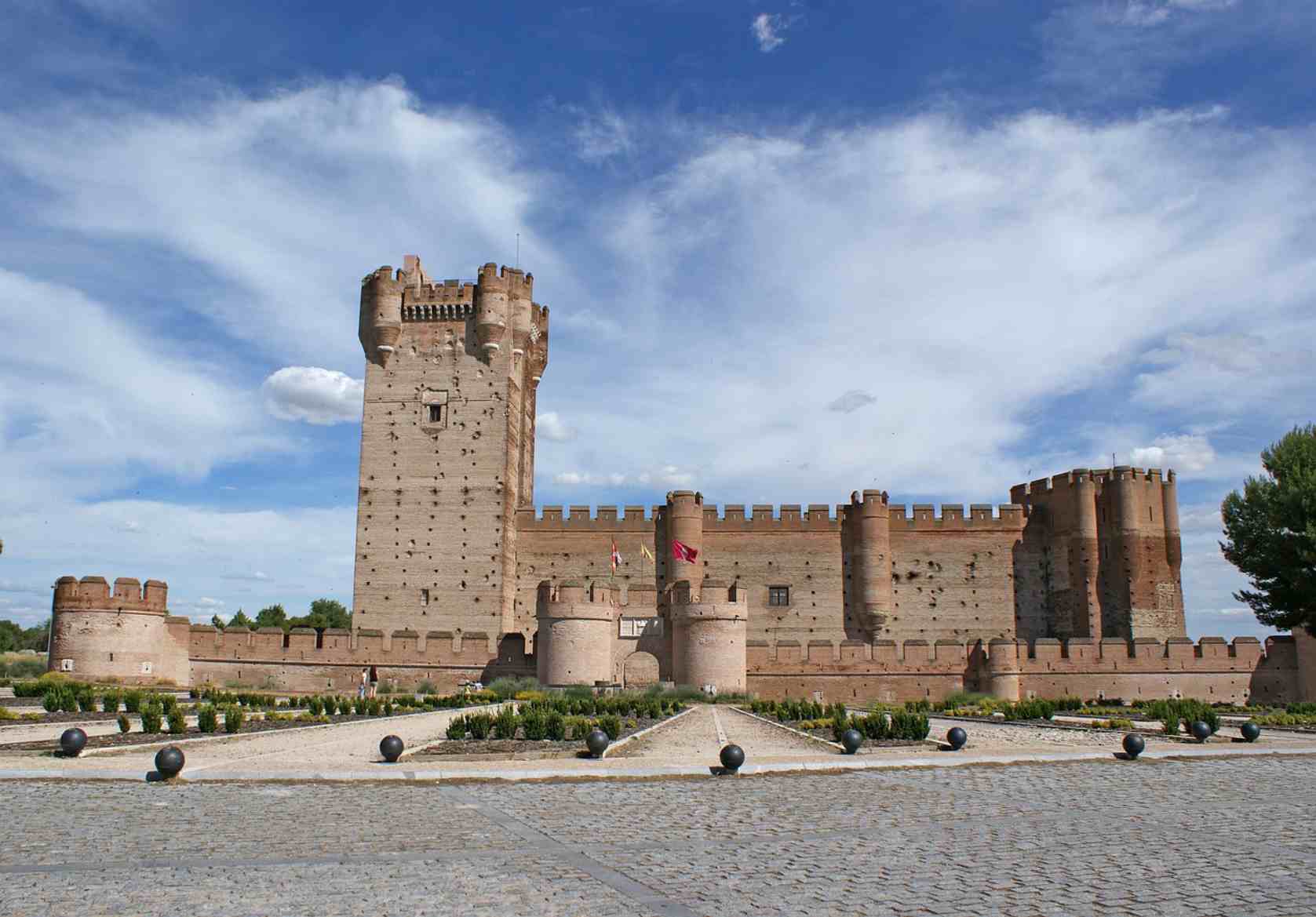
Many of these strongholds played important roles during the Reconquista, serving as military outposts, noble residences and symbols of power for influential families and religious orders.
Today, several of León’s historic castles remain remarkably preserved, attracting cultural travellers, history enthusiasts and visitors exploring northern Spain.
Grajal de Campos Castle
Located in eastern León, Grajal de Campos Castle is considered one of the first artillery fortresses constructed in Spain.
Built in the early 16th century on the orders of Hernando de Vega, the fortress features a square design reinforced by four corner towers.
Although parts of the interior have deteriorated over time, the castle retains much of its original appearance and historic atmosphere.
Cornatel Castle
Cornatel Castle rises dramatically above Villavieja in the Bierzo region, overlooking a strategic landscape near Las Médulas.
The fortress dates back to the High Middle Ages and suffered major damage during conflicts including the Irmandiño Revolt.
Now recognised as a protected cultural site, the castle hosts historical re-enactments and cultural events throughout the year.
Castle-Palace Of The Marquises
In Villafranca del Bierzo, the Castle-Palace of the Marquises combines defensive military architecture with aristocratic residential design.
Constructed during the 16th century, the building was closely associated with the Osorio and Pimentel noble families and became an important landmark along the Camino de Santiago.
The property remains privately owned and has been exceptionally well preserved.
Coyanza Castle
The fortress of Coyanza in Valencia de Don Juan is considered one of León’s finest medieval castles.
Originally dating back to the 11th century, the structure underwent extensive renovations during the 14th century under the House of Acuña.
Situated beside the River Esla, the castle now includes a museum explaining the history and evolution of the fortress.
Ponferrada Castle
Ponferrada Castle, also known as the Templar Castle, is one of the most iconic medieval landmarks in León.
The Knights Templar expanded the fortress during the 12th century to protect pilgrims travelling along the Camino de Santiago.
Today, the monumental complex features a drawbridge, fortified walls and large courtyards adapted for tourism and cultural events.
Gaudí Palace In Astorga
Although not technically a castle, the Episcopal Palace of Astorga stands out for its fortress-like Neo-Gothic appearance.
Designed by Antoni Gaudí in the late 19th century, the building was constructed after the previous episcopal palace was destroyed by fire.
Its towers, arches and dramatic use of light make it one of the most distinctive buildings in León and one of Gaudí’s few works outside Catalonia.
Pimentel Castle
Pimentel Castle in Alija del Infantado occupies a fortress site documented as early as the 10th century.
The structure was transformed over time into both a defensive stronghold and noble residence, with thick walls, square layouts and corner towers still visible today.
Recent restoration projects have helped preserve the complex in excellent condition.
Quiñones Castle
Quiñones Castle in Villanueva de Jamuz was commissioned during the 15th century by Diego Fernández de Quiñones.
The fortress later became associated with Suero de Quiñones, remembered in Spanish history for his participation in famous medieval tournaments and jousts.
Although partially ruined, the castle still preserves its main tower, circular turrets and decorated entrance bearing the family coat of arms.
León Strengthens Cultural Tourism Appeal
León’s medieval castles continue playing an important role in northern Spain’s cultural tourism sector, attracting visitors interested in architecture, history and the heritage of the former Kingdom of León.
The growing popularity of heritage tourism and Camino de Santiago travel has also increased international interest in the province’s historic fortresses and preserved medieval landscapes.