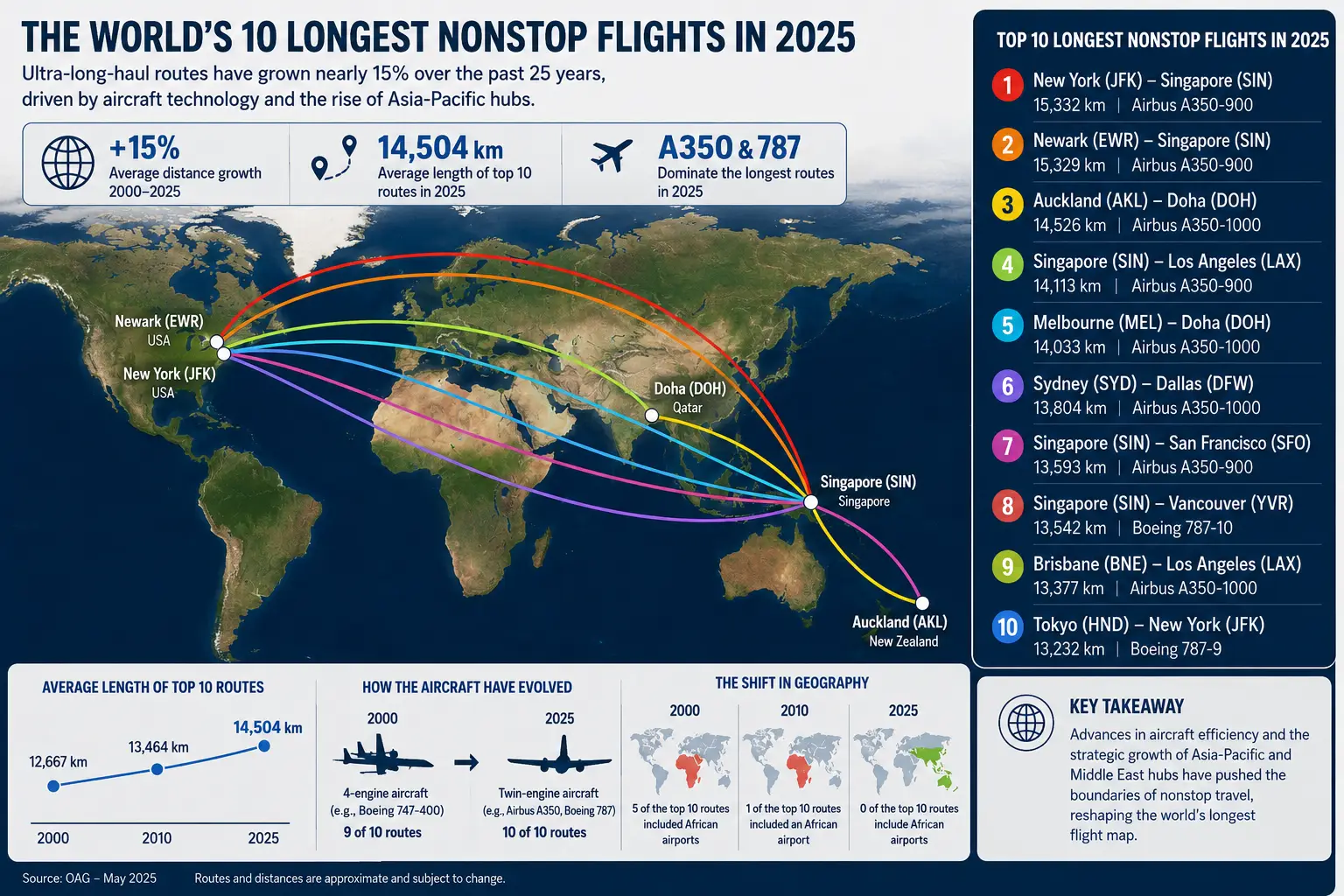
The average distance of the world’s longest non-stop flights has increased by almost 15 per cent over the past 25 years as airlines continue benefiting from advances in aircraft efficiency, lighter airframes, and more reliable long-haul engines.
According to aviation analytics company OAG, the average distance across the world’s top 10 longest non-stop routes reached 14,504 kilometres in 2025, compared with 13,464 kilometres in 2010 and 12,667 kilometres in 2000.
New-Generation Aircraft Reshape Ultra-Long-Haul Travel
In 2000, nine of the world’s ten longest commercial routes were operated using four-engine Boeing 747-400 aircraft.
By 2025, the ultra-long-haul segment has become dominated by highly fuel-efficient twin-engine aircraft including the Airbus A350 and Boeing 787 Dreamliner.
Industry analysts say improvements in fuel efficiency, aircraft range capability, engine reliability, and lightweight composite materials have enabled airlines to operate significantly longer non-stop flights more economically.
Asia-Pacific Airports Expand Global Dominance
The geography of ultra-long-haul aviation has also shifted dramatically over the past quarter century.
In 2000, African airports featured in five of the world’s ten longest routes, largely driven by South African Airways services linking Johannesburg with Atlanta, New York, and Cape Town.
By 2010, only one African route remained in the top 10 — Delta Air Lines’ Atlanta to Johannesburg service.
In 2025, no African airport appears among the world’s ten longest non-stop routes.
Meanwhile, Asia-Pacific hubs have significantly expanded their presence in the ultra-long-haul market.
In 2000, four of the top ten longest routes involved Asia-Pacific airports. By 2025, airports across the region are represented on all ten of the world’s longest non-stop commercial flights.
Singapore And Gulf Hubs Drive Market Growth
OAG said the shift reflects the growing strategic importance of hubs including Singapore, Auckland, and major Australian gateways within global long-haul aviation networks.
The continued expansion of Gulf airline hubs connecting Asia and Australia has also played a major role in reshaping ultra-long-haul travel patterns.
Singapore Airlines Operates World’s Longest Flight
Singapore Airlines currently operates the world’s longest non-stop route in 2025 between New York JFK and Singapore Changi, covering 15,332 kilometres using the Airbus A350-900.
The airline also operates the second-longest route globally between Newark and Singapore at 15,329 kilometres.
Third place belongs to Qatar Airways’ Auckland to Doha service, spanning 14,526 kilometres and operated using the Airbus A350-1000.
Ultra-Long-Haul Segment Continues Expanding
The ultra-long-haul market continues attracting investment from airlines seeking premium business traffic, network efficiency, and direct connectivity between major global cities.
Industry forecasts suggest future aircraft developments could enable even longer commercial non-stop routes in the coming years as carriers continue expanding global connectivity.