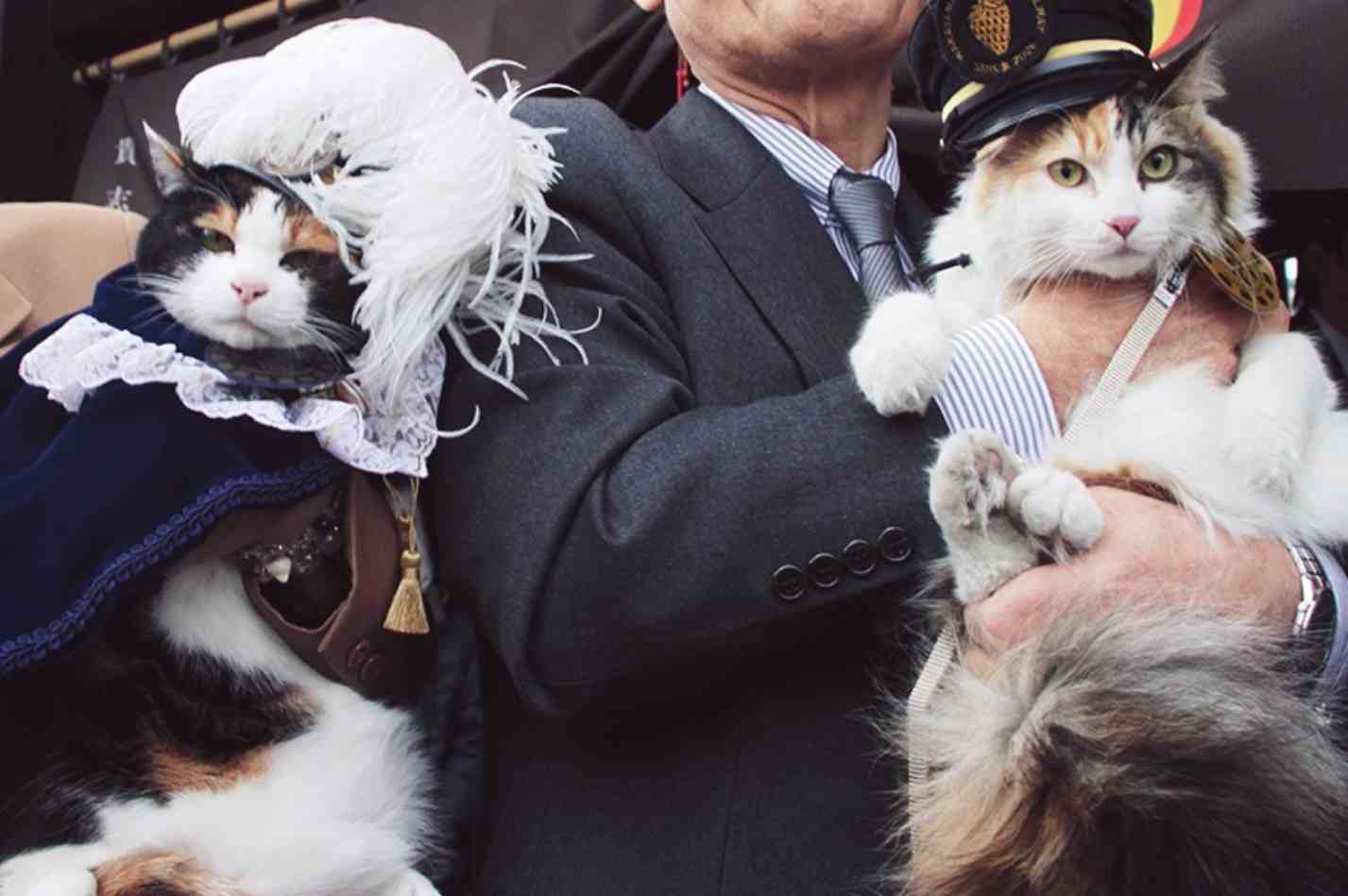
Two ordinary house cats have been formally appointed as station masters at railway stations in southern Japan, according to the official website of Wakayama Electric Railway.
The cats, named Yontama and Fukutama, received their new titles during a ceremonial event attended by company officials, local authorities, and residents. Yontama was appointed station master at Kishi Station, while Fukutama will serve in the same role at Idakiso Station. A third cat, the calico Rokutama, has been named a candidate and will undergo training at both stations.
Under their official duties, the feline station masters “work” from specially adapted offices converted from former ticket booths, greet passengers with their presence, and help attract tourists to the Kishigawa Line. They wear station master hats, follow scheduled working hours, and receive a salary paid in food.
More than 200 people attended the appointment ceremony, including representatives of the local government and residents of the area.
A long-running railway cat tradition
The practice of appointing cats as station masters in Wakayama Prefecture began in January 2007, when an eight-year-old cat named Tama was given the role at Kishi Station. At the time, the Kishigawa Line was facing possible closure due to financial difficulties, and railway officials hoped the unusual move would boost passenger numbers.
The strategy proved highly successful. Passenger traffic reportedly increased by 17 percent in the first month alone, while tourism linked to Tama generated an estimated 1.1 billion yen for the local economy. Tama later received several promotions, eventually becoming “honorary president” of the railway company. In 2010, Kishi Station itself was rebuilt with a cat-themed design.
After Tama’s death in June 2015, she was buried according to Shinto rites and enshrined as a local deity, with a small shrine erected on the station platform.
The role was later taken over by other cats whose names all include the suffix “tama”. Tama’s successor, Nitama, served as station master for a decade until his death in late 2025. Yontama and Fukutama have now assumed the mantle, with Rokutama expected to follow in the future.
Part of Japan’s “cat economy”
The Wakayama railway cats are widely seen as part of a broader phenomenon in Japan known as “neconomics”, or the “cat economy”. The use of cats as mascots and symbolic figures has been shown to generate significant economic benefits, drawing media attention, tourists, and commercial interest to businesses and regions.
Photo credit: visitwakayama.jp