
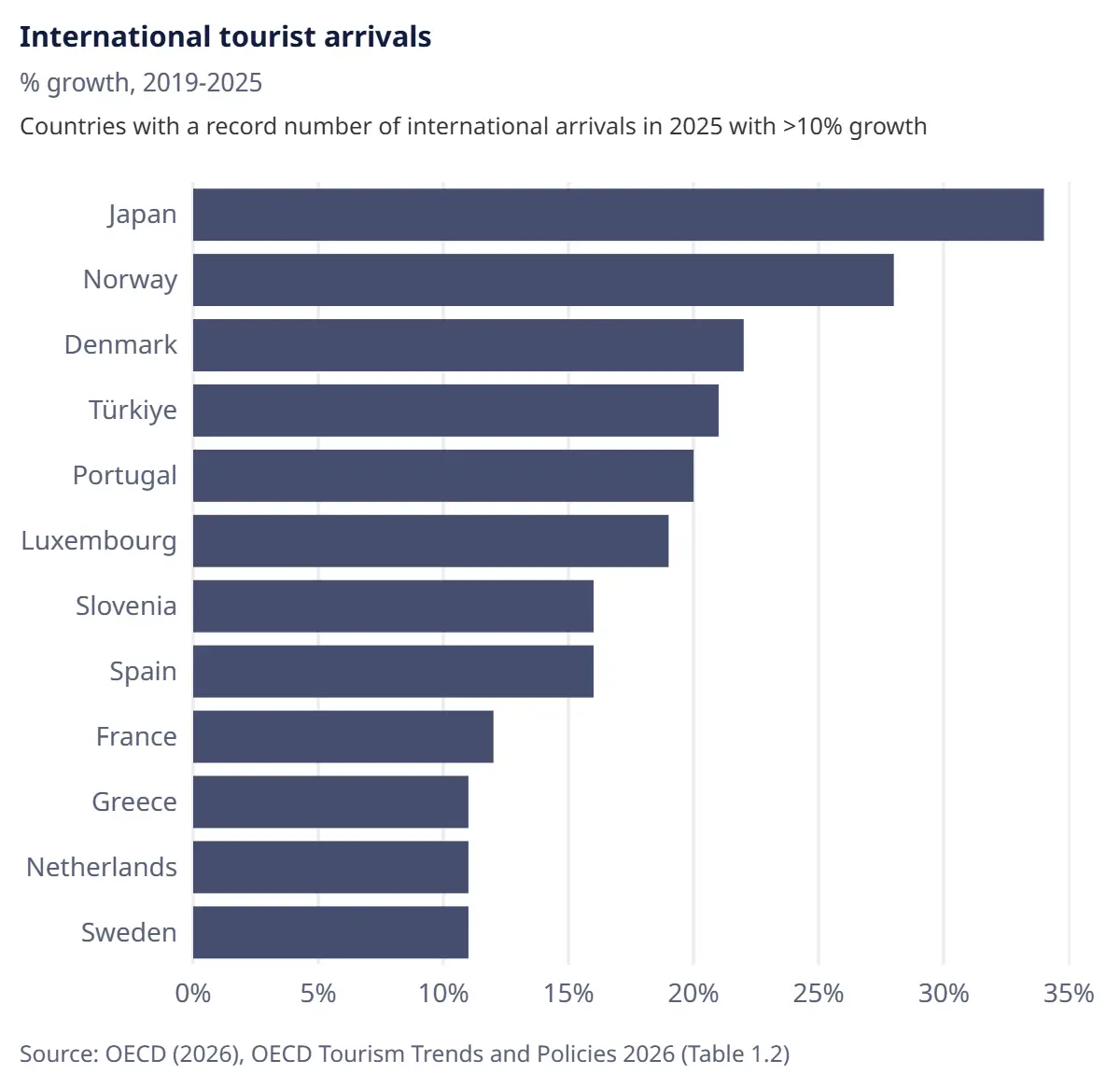
International tourist arrivals across OECD countries reached a record estimated 847 million in 2025, increasing 3.4% from the previous year and continuing the sector’s strong recovery, according to the latest OECD Tourism Trends and Policies 2026 report.
The growth follows an 8.1% increase in international arrivals in 2024, demonstrating the continued resilience of global tourism. However, the OECD warns that geopolitical tensions, changing traveler preferences, and increasingly frequent extreme weather events are creating new challenges that destinations and tourism businesses must prepare for.
The report highlights the ongoing conflict in the Middle East as a significant source of disruption for international travel. The conflict has affected air connectivity, increased travel costs, and weakened consumer confidence, particularly impacting destinations in the region and countries that rely heavily on Gulf aviation hubs.
OECD Secretary-General Mathias Cormann said tourism continues to generate jobs, business opportunities, and tax revenues across member countries, but stressed that governments and the private sector must strengthen crisis preparedness and improve the management of visitor flows to ensure sustainable long-term growth.
According to the report, concerns about safety, affordability, and potential travel disruptions are increasingly influencing consumer behavior. Travelers are showing greater preference for familiar destinations, shorter vacations, and lower-cost travel options as economic uncertainty and geopolitical risks continue to shape demand.
The OECD noted that airlines, tour operators, and tourism businesses are already adapting their strategies for 2027 and beyond as they respond to evolving geopolitical, economic, and climate-related risks.
Strongest Tourism Growth in 2025
Among OECD members, Finland recorded the highest growth in international tourist arrivals during 2025, with inbound tourism increasing by 16.5% compared with the previous year. Japan followed with growth of 15.8%, closely ahead of Korea at 15.7%, while Norway recorded a 12.5% increase.
Japan and Korea continued the momentum established in 2024, when international arrivals surged by 47.1% and 48.4%, respectively, supported by expanded international air connectivity and favorable exchange rates.
Markets Still Facing Challenges
Not all destinations experienced growth. International arrivals declined in Canada (-0.6%), Germany (-0.8%), Ireland (-2.8%), and the United States (-5.5%) during 2025, with all four countries remaining below their pre-pandemic visitor levels.
Israel continues to face the most significant tourism challenges, with international arrivals remaining 70.8% below pre-pandemic levels due to the ongoing regional conflict.
Despite the mixed performance across individual markets, the OECD’s latest survey indicates continued optimism. Around one-third of member countries expect tourism performance to exceed 2025 levels by the end of 2026, with many anticipating new records for international visitor arrivals.
The report concludes that while global tourism remains on a positive growth trajectory, future success will depend on destinations’ ability to adapt quickly to geopolitical uncertainty, climate-related disruptions, and changing traveler expectations while building greater resilience across the sector.