
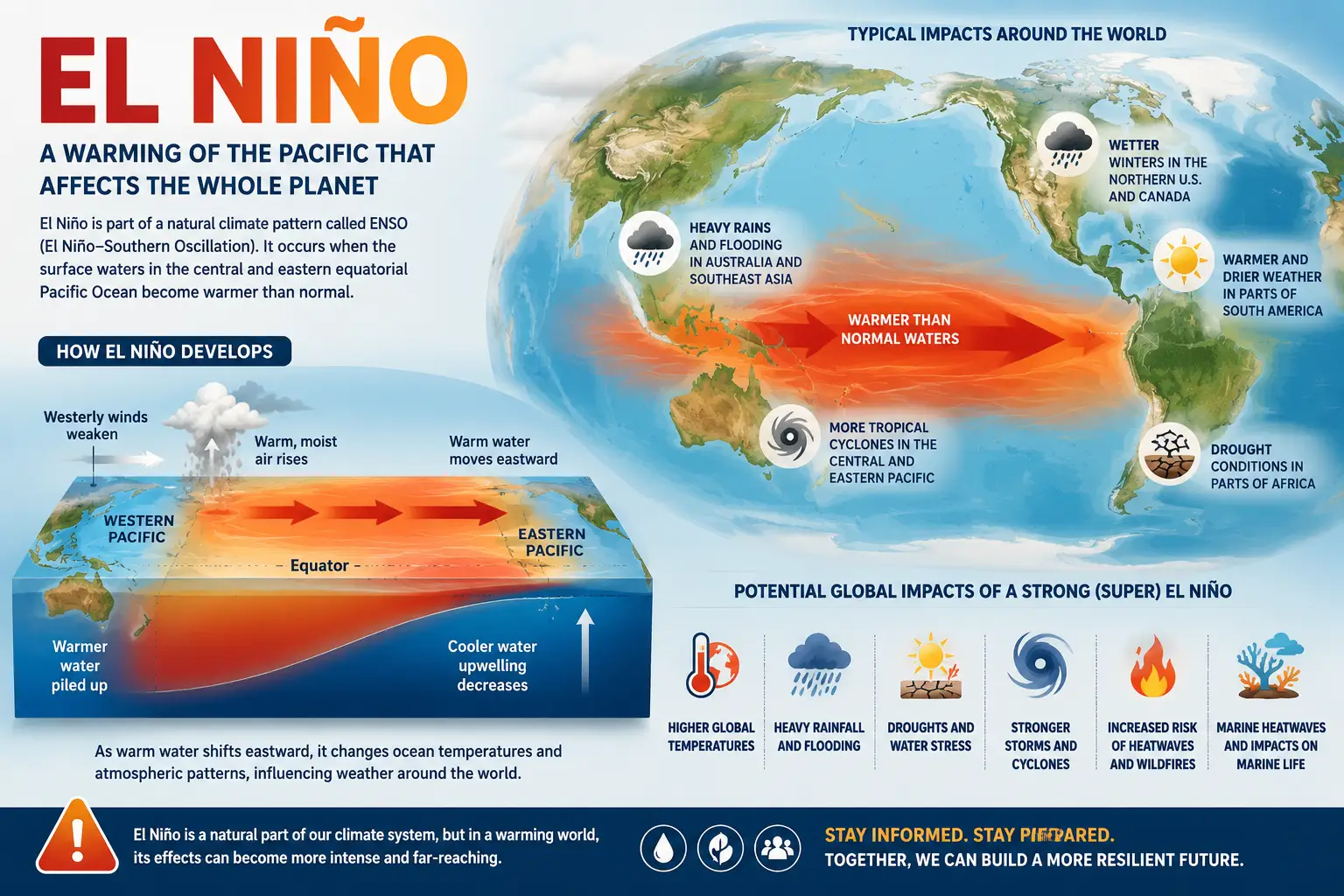
Several forecasting models indicate that warming conditions may begin developing in the equatorial Pacific during the summer of 2026 and potentially continue into 2027.
Potential “Super El Niño” Raises Concern
Scientists are particularly focused on the possibility that the event could evolve into a so-called “super El Niño,” a term used when sea surface temperatures in parts of the equatorial Pacific rise more than approximately 2°C above average.
Such events can significantly disrupt global weather systems and amplify climate extremes.
The warming does not remain limited to the ocean itself. Excess heat stored in Pacific waters is transferred into the atmosphere, altering large-scale circulation patterns across the planet.
Global Weather Patterns Could Shift
El Niño forms part of the natural ENSO cycle, or El Niño-Southern Oscillation, which periodically shifts ocean and atmospheric conditions across the Pacific Ocean.
When El Niño develops, rainfall patterns, storm systems and temperatures often change across multiple regions worldwide.
Historically, strong El Niño events have been associated with heatwaves, droughts, flooding and intensified storms in different parts of the world.
Natural Climate Variability And Global Warming Could Combine
Researchers warn that the next El Niño could occur alongside long-term global climate warming, potentially amplifying temperature anomalies even further.
If forecasts prove accurate, the combination of natural ocean warming and ongoing climate change could push global temperatures to new records during 2026 and 2027.
Extreme Weather Risks May Increase
Climate models suggest that stronger El Niño conditions could increase the frequency and intensity of extreme weather events globally.
Potential impacts may include prolonged droughts in some regions, heavier rainfall in others, marine heatwaves and additional pressure on already stressed ecosystems.
Scientists continue emphasizing that El Niño itself is a naturally occurring climate phenomenon, although rising global temperatures may intensify some of its effects.
Forecasts Still Subject To Change
While long-range forecasting models increasingly indicate a strengthening El Niño signal, meteorologists caution that ocean-atmosphere systems remain highly complex and projections may still evolve over the coming months.
Research centres worldwide are continuing to closely monitor Pacific Ocean conditions for further signs of sustained warming.