
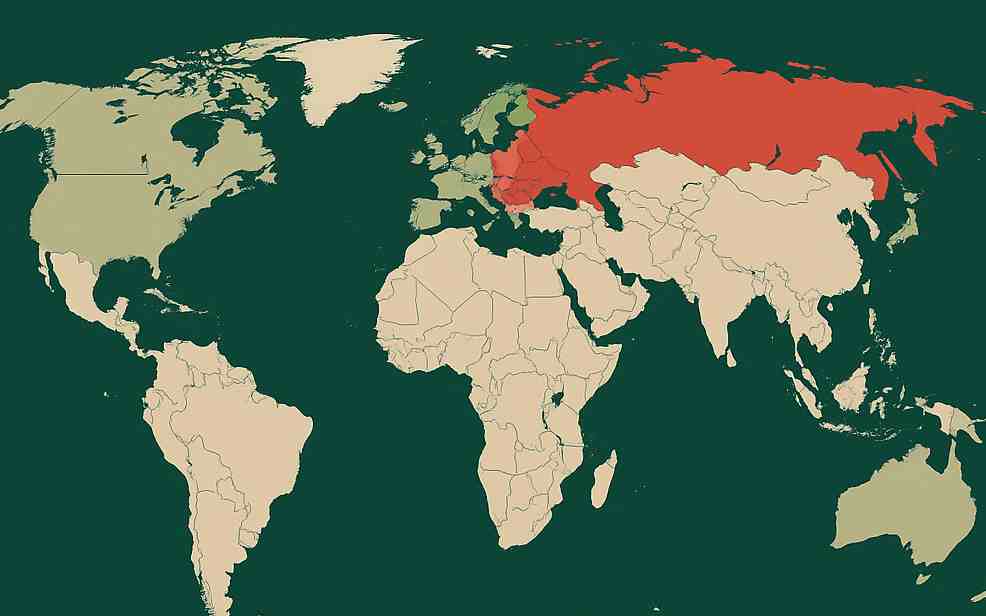
According to data published by World Population Review, Ukraine has been ranked the world’s least peaceful country in 2024 based on the Global Peace Index (GPI) – an international measure of security and stability. The GPI is used to assess the relative safety of countries through a range of factors including violent crime rates, relations with neighboring states, involvement in conflicts, frequency of terrorist incidents, and government stability.
The review notes that a higher GPI score corresponds to lower levels of peace and safety. As of 2024, the five countries with the highest (and therefore worst) GPI scores are Ukraine, Russia, Belarus, Cyprus, and France. Following them are Moldova, Bosnia and Herzegovina, Serbia, Albania, and Greece.
World Population Review highlights that the ongoing war in Eastern Europe and political instability across parts of the continent have significantly influenced the rankings. The report’s findings mirror broader global security trends, showing increased tension in regions affected by conflict or geopolitical divisions.
Meanwhile, Euronews, citing Eurostat and the European Parliamentary Research Service, published its own analysis of safety levels within Europe. While the continent remains one of the world’s safest overall, the report found a growing number of citizens reporting local crime, violence, or vandalism.
According to Eurostat data, about 10% of EU citizens said they had experienced or witnessed crime or acts of vandalism in their neighborhoods. The highest rates of such reports were recorded in Greece, the Netherlands, Bulgaria, France, Spain, and Belgium.
At the opposite end of the scale, the safest European countries were listed as Croatia, Lithuania, Poland, Slovakia, and Estonia, where fewer than 5% of residents reported experiencing local crime or violence.
Despite rising concerns about security in parts of Europe, analysts emphasize that the continent as a whole continues to maintain relatively low crime rates compared to other regions of the world — though economic pressures, migration challenges, and online radicalization are testing its long-standing sense of stability.