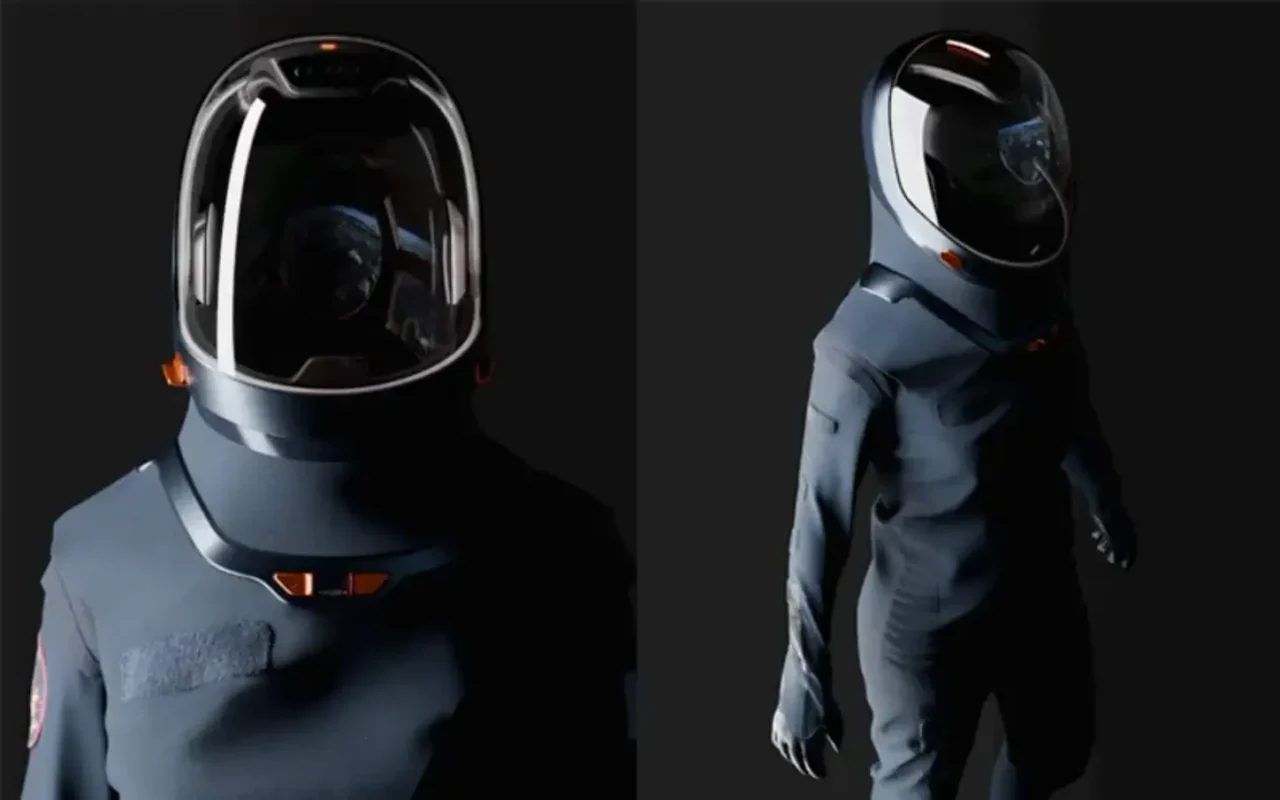
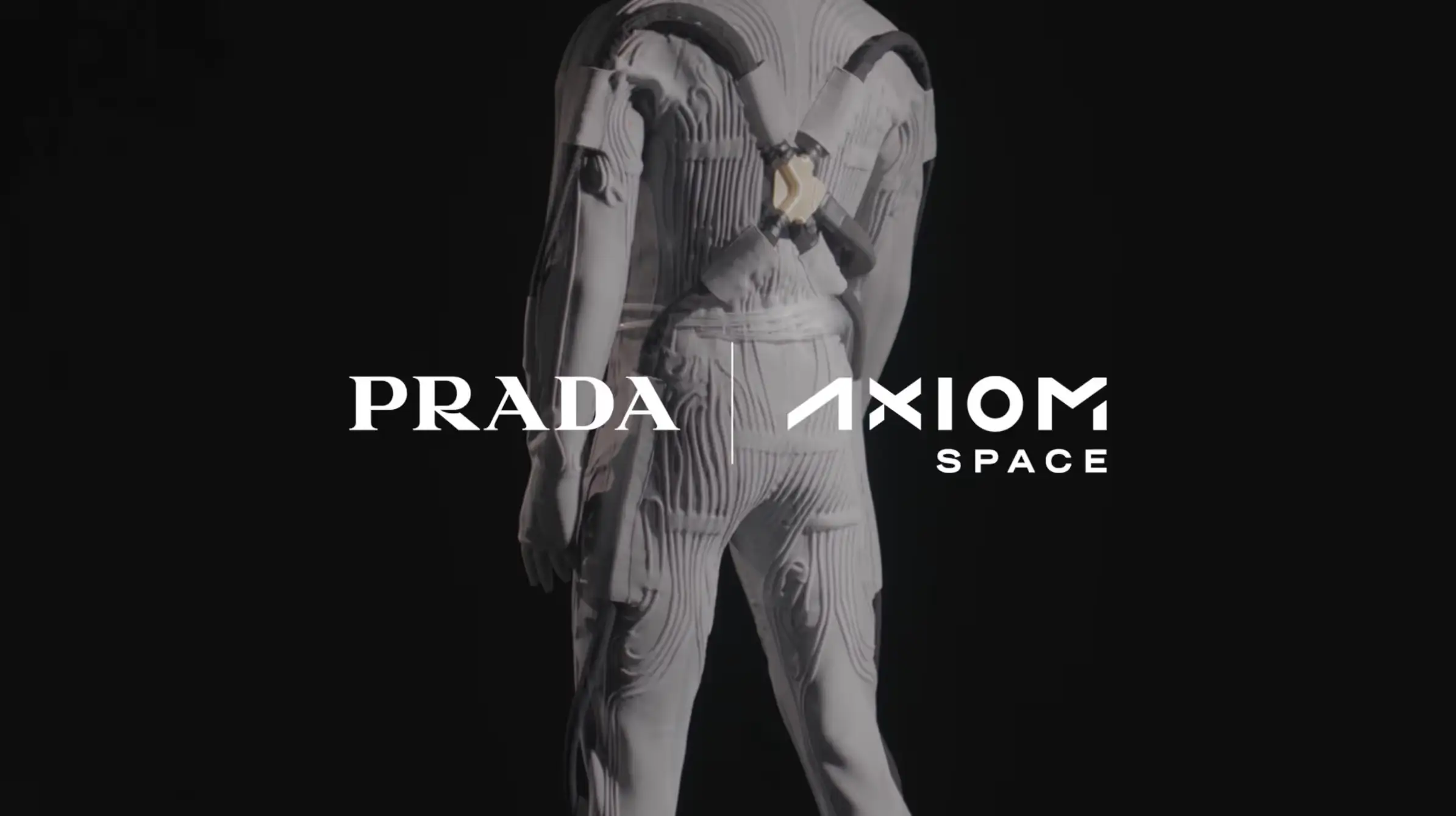
Axiom Space and Prada have unveiled the liquid cooling and ventilation garment that astronauts will wear inside the AxEMU lunar spacesuit, marking a notable shift in one of the most closely watched partnerships in modern spaceflight. When the two companies first revealed their collaboration, much of the attention naturally focused on the unlikely pairing itself – a commercial space company and one of Italy’s most recognisable luxury fashion houses working together on a Moon suit. But this latest reveal changes the conversation. The partnership is no longer just about the outer appearance and protective shell of a lunar spacesuit. It has now moved inward, into one of the most critical systems astronauts will depend on when they step onto the lunar surface: the layer responsible for keeping their bodies cool, ventilated and physically functional during hours of intense work in one of the harshest environments imaginable.
The real story is not that Prada is in space – it is that Prada is now working on the suit layer astronauts depend on most
The most interesting angle in this announcement is not the celebrity factor of a luxury brand entering the space sector. That headline has already been written. The more meaningful development is that Prada is now involved in one of the most technically sensitive layers of the spacesuit architecture – the one that directly affects astronaut endurance, thermal regulation and habitability. This is a very different proposition from designing a visually distinctive outer layer or contributing to material choices for the suit shell. The LCVG is not decorative and it is not symbolic. It is a life-support garment.
As astronauts work outside a spacecraft or habitat, their bodies generate large amounts of metabolic heat. On Earth, that heat can dissipate through air, sweat and natural convection. On the Moon, none of those mechanisms work in the same way. Inside a sealed spacesuit, the human body can quickly become a thermal management problem. The LCVG solves that by circulating cold water through a network of tubes routed across the body’s major muscle groups, drawing heat away and transferring it to the suit’s portable life-support system so it can be expelled into space. At the same time, a separate ventilation loop pushes fresh oxygen across the astronaut’s face and clears away exhaled carbon dioxide, routing it back through the suit’s scrubber system before recirculating breathable oxygen.
That makes the garment one of the least visible but most essential parts of the entire suit. If the outer shell protects the astronaut from the environment, the LCVG protects the astronaut from the consequences of being sealed inside the suit itself.
This is where the Prada partnership stops looking like a branding exercise and starts looking like systems engineering
There has always been a temptation to frame the Axiom-Prada partnership as a marketing masterstroke – a luxury house lending glamour and cultural weight to a next-generation lunar programme. That element was never entirely absent. But with the unveiling of the LCVG, it becomes harder to dismiss the collaboration as primarily aesthetic. Axiom says Prada contributed expertise in engineered knitting, advanced materials, patternmaking and 3D modelling, all of which fed into the development of a garment that must maintain cooling performance, improve comfort and withstand repeated use during long-duration missions.
That matters because spacesuit design is, in many ways, a problem of wearable systems engineering. It is not enough for a garment to be strong or lightweight. It must fit precisely, move with the body, tolerate prolonged physical exertion, interface cleanly with other suit systems and maintain performance across repeated cycles of use. In that sense, the jump from high-end technical apparel to certain elements of spacesuit development is not as far-fetched as it first appears. Prada’s expertise in engineered textiles and precision garment construction is relevant precisely because the LCVG sits at the point where the body meets the machine.
The lesson here is broader than Prada itself. Space hardware is increasingly being shaped by cross-industry collaboration, where specialist capabilities from outside aerospace can contribute to problems that traditional contractors do not solve alone. The future of human spaceflight may depend as much on unconventional partnerships and hybrid supply chains as it does on rockets and capsules.
The AxEMU suit is being built for a much tougher Moon than the one astronauts visited in the Apollo era
The timing of the announcement is also significant because it reflects the reality of what lunar exploration now demands. When astronauts return to the Moon under NASA’s Artemis programme, they will not be repeating Apollo in a simple nostalgic loop. They will be heading into a more ambitious operational environment, with longer excursions, more complex surface activity and a stronger emphasis on sustainability, mobility and repeat use. The lunar South Pole, where future crews are expected to work, presents especially demanding conditions, including deep cold, abrasive dust, sharp thermal swings and terrain that is far more operationally challenging than the imagery of Apollo-era Moonwalks might suggest.
That means every layer of the suit has to work harder. A cooling garment is no longer just an underlayer that makes the mission more comfortable. It becomes part of the mission architecture itself. If astronauts are expected to work for extended periods collecting samples, deploying equipment, moving across uneven ground and potentially living in more sustained lunar operations, then thermal management and breathable airflow are not secondary issues. They are fundamental to mission duration, productivity and safety.
Axiom’s LCVG is designed with that in mind. The company says the system includes a fully redundant cooling circuit, so that if the primary loop fails, a backup remains available. That redundancy is a crucial detail because it reveals how the garment is being treated: not as clothing, but as infrastructure. In deep space operations, any component that directly affects thermal regulation and respiration must be engineered around failure tolerance, not just performance.
The invisible layer inside the spacesuit may be one of the most important technologies astronauts wear
There is something slightly counterintuitive about the LCVG story. In a world of glossy spacesuit reveals and public fascination with what astronauts will look like on the Moon, the most important advancement may be one the public will barely see. The LCVG is hidden beneath the outer suit. It will not dominate photographs in the way the helmet, visor or white suit shell will. Yet it is one of the few layers standing directly between the astronaut and the cumulative physical stress of the lunar environment.
That makes it a useful reminder of how human spaceflight actually works. The success of a Moon mission does not rest only on dramatic hardware such as landers, launch systems or rovers. It also depends on the quiet, unglamorous technologies that keep the human body functioning minute by minute. Temperature regulation, oxygen circulation, carbon dioxide removal, mobility, fatigue reduction and garment reliability are not side notes to exploration. They are exploration. They determine how long a person can stay outside, how safely they can work and how much useful activity can be accomplished before the suit becomes the limiting factor.
In that sense, the LCVG belongs to a class of technologies that rarely dominate public imagination but fundamentally define what is operationally possible. It is the sort of system that does not need to be visible to be consequential.
Axiom is building a lunar suit for NASA, but also making a case for commercial leadership in human spaceflight
The Prada collaboration also fits into Axiom Space’s broader positioning in the space economy. Axiom is not simply developing a suit for one NASA mission. It is trying to establish itself as a long-term commercial infrastructure player in human spaceflight, spanning spacesuits, private space stations and the wider ecosystem that could support government and commercial missions alike. The AxEMU is part of that strategy. Every layer of the suit that Axiom can demonstrate as innovative, reliable and mission-ready strengthens its claim to be more than a contractor – it strengthens its image as a company building foundational human-spaceflight systems for the next era.
That is one reason the Prada relationship matters beyond its novelty. It helps Axiom tell a bigger story about how advanced consumer-industry expertise can be folded into commercial space development. If the collaboration succeeds, it becomes a template: not merely for fashion involvement in aerospace, but for how non-traditional industrial partners can contribute to the design of life-supporting hardware. The LCVG is arguably the clearest proof point yet that the partnership has real engineering substance behind it.
The suit itself is becoming a platform for innovation across materials, wearability and mission endurance
Spacesuits are often treated in public discourse as singular objects, but in reality they are integrated systems made up of layers, loops, seals, interfaces and support components that must all work in harmony. What makes the AxEMU project interesting is that Axiom appears to be treating each of those layers as an opportunity for reinvention rather than simply a legacy design to be updated. The outer shell has already been presented as a response to the lunar South Pole’s thermal extremes and micrometeoroid environment. Now the LCVG shows that the company is also rethinking the human interface layer, where comfort, breathability and endurance meet the physics of life support.
That is important because the future of lunar and deep-space operations will likely demand more from suits than previous generations ever did. Astronauts will need to move farther, stay out longer and perform more complex tasks. Suits must therefore evolve from protective garments into something closer to mobile habitats – tightly integrated systems that allow the human body to operate efficiently in environments it was never meant to survive. The more those systems can reduce fatigue, improve range of motion and maintain stable internal conditions, the more capable astronauts become on the surface.
The LCVG sits squarely in that evolution. It is a garment, but it is also a performance system. It regulates heat, manages airflow, supports breathing and forms part of the operational endurance envelope of the astronaut wearing it. That is why its unveiling matters.
Prada’s role points to a wider trend: space hardware is becoming a convergence industry
There is a broader industry lesson embedded in this announcement. Human spaceflight is increasingly drawing from sectors that would once have seemed peripheral to aerospace – advanced apparel, industrial design, consumer electronics, digital modelling, specialised textiles and high-performance materials manufacturing. The barriers between these disciplines are softening because the problems being solved are increasingly interdisciplinary. A spacesuit is simultaneously a pressure vessel, a life-support interface, a thermal management system, a mobility device and a wearable product that must fit a human body under stress.
That complexity rewards cross-pollination. Prada’s contribution to engineered knitting and material selection may sound unusual in a space context, but it makes more sense when viewed through the lens of product development rather than traditional aerospace categories. The same is likely to be true of future collaborations across robotics, habitat interiors, food systems and in-space health technologies. The space sector is moving toward a model where expertise from luxury goods, automotive, medicine, advanced manufacturing and digital design can all find highly specific applications in mission hardware.
The Axiom-Prada partnership is therefore interesting not only because it is unexpected, but because it may become less unusual over time. As commercial spaceflight grows, more of its most useful innovations may come from the edge where industries overlap.
The Moon return narrative is often about rockets and geopolitics – but the suit still has to work minute by minute
Much of the public conversation around Artemis and the return to the Moon tends to focus on launch schedules, national prestige, lunar bases and geopolitical competition. Those stories are real, but they can overshadow the operational reality of what a Moon mission actually asks of the human body. Once astronauts are on the surface, the mission becomes intensely physical. Every step, every tool deployment, every sample collection and every minute spent outside depends on the suit functioning as a personal spacecraft.
That is why the unveiling of the LCVG deserves more attention than it might initially attract. It is not just another component reveal in a long programme timeline. It is a reminder that the return to the Moon will be won or lost through countless technical details that determine whether astronauts can remain safe, productive and physically stable in a hostile environment. The glamour of a Moon mission may sit in the launch and the landing. The hard truth of it sits inside the suit.
Axiom and Prada are making a bigger claim than a product launch
In announcing the LCVG, both companies are effectively making the same argument: that the next era of human spaceflight will be built through combinations of expertise that would once have seemed improbable. Axiom gets to demonstrate that it is building serious lunar systems, not just generating headlines. Prada gets to show that its role in the partnership is rooted in technical contribution, not just visual association. Together, they are trying to prove that advanced craftsmanship, material science and aerospace engineering can meet in a single garment that astronauts will rely on when they return to the Moon.
The result is a story that is more interesting than the usual space-fashion headline. The real significance of the new garment is not that Prada has helped design something astronauts will wear. It is that Prada is now part of the layer that helps keep those astronauts cool, breathing and operational while they work on the lunar surface. That is no longer a branding exercise. It is part of the life-support stack of the Artemis era.