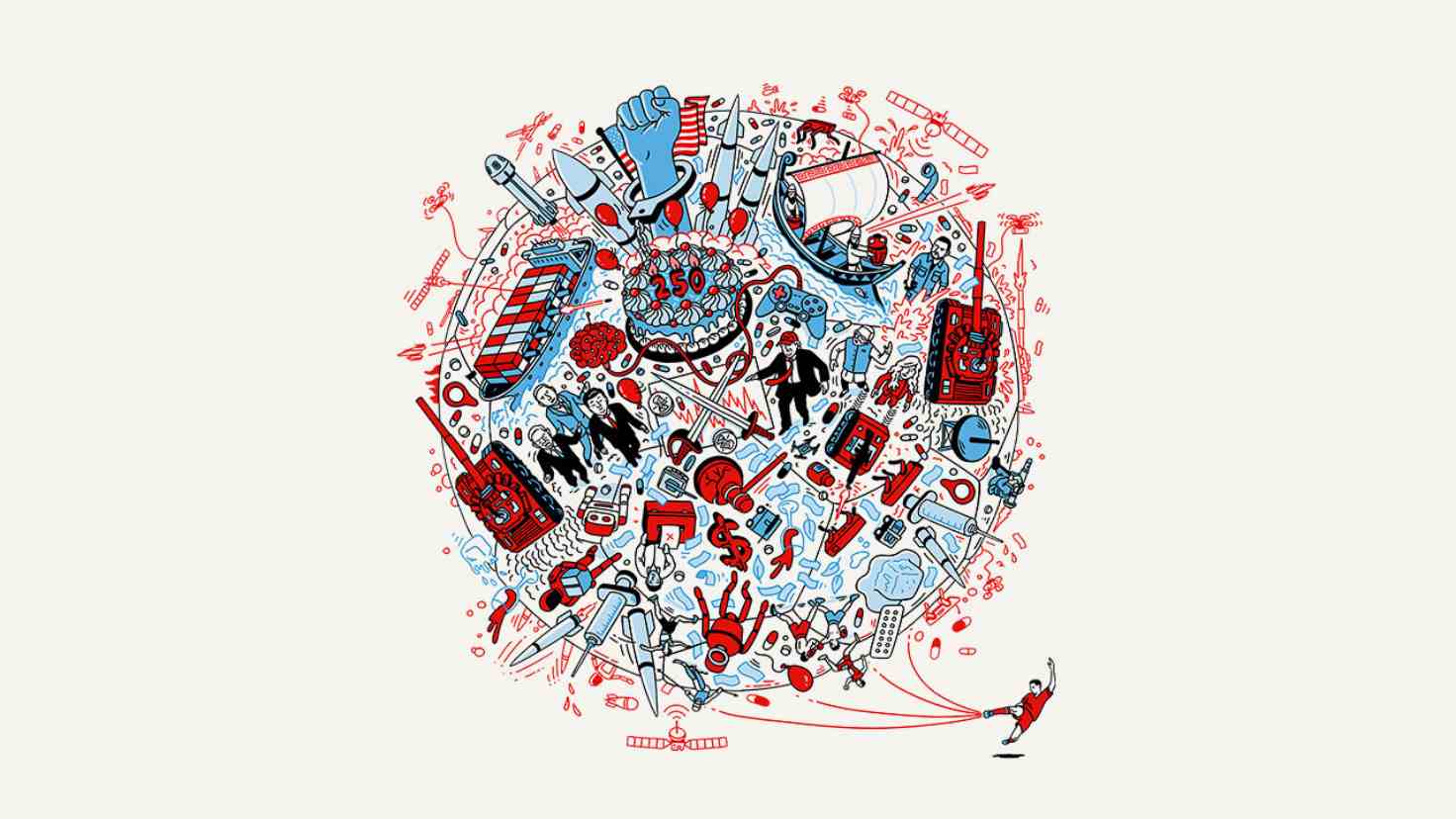
The Economist has launched The World Ahead 2026, the newest edition of its long-running annual that examines the forces shaping the coming year. Now in its fortieth year, the special issue has become one of the publication’s most anticipated releases, a moment when its editors step back to map the global dynamics, tensions and opportunities that will define the year ahead. The 2026 edition appears both as part of the weekly print issue dated November 15 and as a stand-alone newsstand publication, with the editor’s top ten themes released online.
This year arrives under the shadow of unpredictability. Tom Standage, editor of The World Ahead, describes 2026 as a year when Donald Trump’s reshaping of global norms will continue to reverberate through diplomacy, trade and alliances. Yet he frames it not only as a moment of disruption but as an inflection point: a year that will reveal whether the world edges toward economic slowdown, geopolitical fragmentation or technological acceleration.
Standage notes the questions looming over the year. Will the intensifying trade war trigger a downturn. Will an AI investment surge ignite innovation or fuel an economic bubble? Could Trump’s unconventional diplomatic style reshape the Middle East in lasting ways? And will bond markets force heavily indebted Western nations to face fiscal reality? The World Ahead 2026 aims to provide clarity on these trends and their implications for governments, businesses and citizens.
The edition’s top ten themes capture the breadth of the uncertainty.
America’s 250th anniversary will divide political narratives, as Republicans and Democrats interpret the country’s trajectory in radically different ways. Geopolitically, analysts cannot decide whether the world is drifting into a new cold war or splitting into spheres of influence dominated by the United States, China and Russia. Conflicts in Ukraine, Sudan and Myanmar will persist, even as fragile calm in Gaza offers a tentative counterpoint. The distinction between war and peace will blur further as competition expands into the Arctic, cyberspace, outer orbit and the sea floor.
Europe faces its own complex balancing act: raising defence spending, keeping America engaged, managing deficits, promoting green initiatives and boosting economic growth, all while avoiding political backlash. China, meanwhile, confronts deflation and slowing growth, yet U.S. protectionism may open new geopolitical and commercial pathways for Beijing.
Economic concerns run through the edition. Tariffs may weigh on global growth, and the risk of a bond-market correction is rising as wealthy nations continue to overspend. At the same time, AI-driven infrastructure investment may be masking deeper economic fragilities. Climate predictions remain mixed: warming will surpass 1.5°C, but global emissions appear to have peaked, and green innovation is flourishing across the global south. Companies are likely to meet or exceed climate targets quietly to avoid political pushback, and geothermal energy is flagged as one to watch.
The cultural front brings its own tensions. The 2026 World Cup, jointly hosted by the United States, Canada and Mexico, may face subdued attendance due to strained trilateral relations. In Las Vegas, the Enhanced Games will draw controversy by openly permitting performance-enhancing drugs, prompting debates over the future of sport. Advances in GLP-1 weight loss medication, arriving in cheaper tablet form, will expand access but raise ethical questions around what constitutes “cheating” in personal health.
Marking the fortieth year of The World Ahead, this edition also includes a special section titled Mapping 2026, which uses maps to explain how geography will shape politics, economics and culture. Readers will also find predictions from the superforecasting team at Good Judgment and an interactive graphic outlining conflicts to watch.
As in previous editions, The Economist invites global leaders and thinkers to contribute. This year includes perspectives from Kaja Kallas of the European Commission, Mark Carney of Canada, Nandan Nilekani of Infosys, former U.S. government lawyers Jack Goldsmith and Robert Bauer, Stanford historian Richard White, IMF managing director Kristalina Georgieva, and vaccine anthropologist Heidi Larson.
Together, they help position The World Ahead 2026 as a guide for navigating a year marked by uncertainty, rivalry, innovation and restrained optimism. It is less a prediction than a framework, and as the world enters a volatile new cycle, the need for such a lens feels particularly acute.