
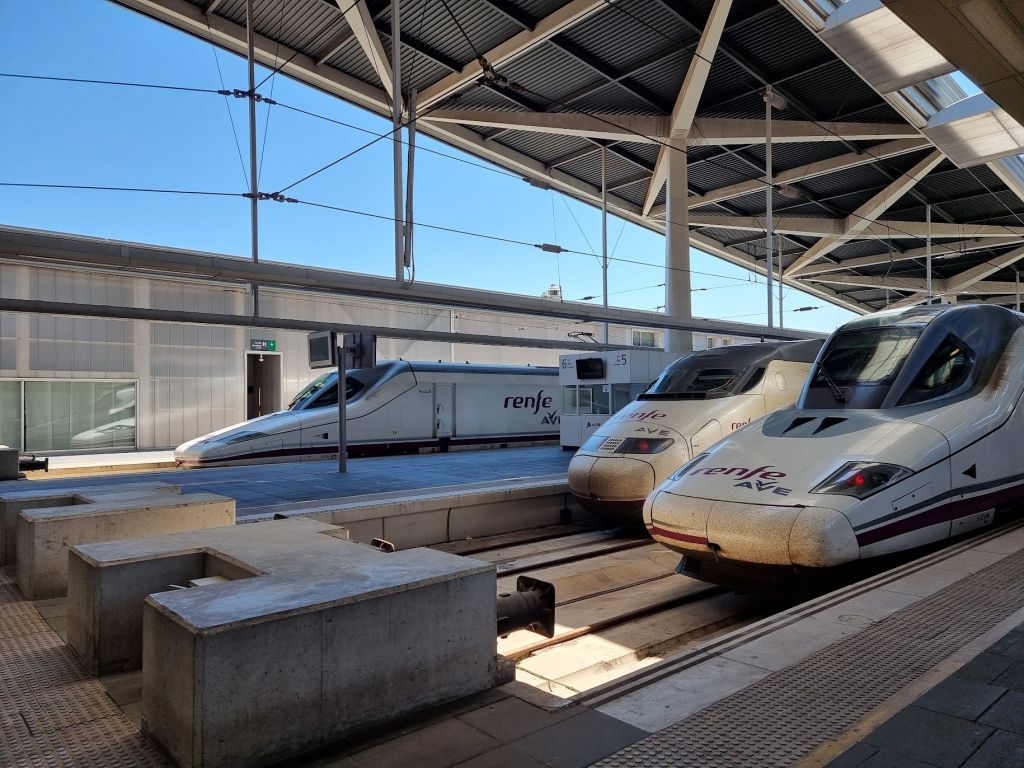
As rising aviation costs and fuel supply concerns force European travellers to reconsider how they move across the continent, Spain’s long-standing transport vulnerability is once again under the spotlight.
For many European tourists, rail travel is the most logical alternative to flying. Trains produce lower emissions, offer greater comfort on long journeys and connect major cities efficiently across central Europe. But Spain remains one of the continent’s most isolated rail markets.
The country’s high-speed rail network still faces a major structural obstacle: the historic difference between Spain’s track gauge and the standard gauge used across most of Europe.
Spain’s Railway Network Still Struggles To Connect With Europe
For decades, the incompatible rail systems forced passengers to change trains at the border or rely on adaptable axle technology.
While international rail services have improved in recent years, including routes linking Barcelona and Paris as well as services between Madrid and Lyon, Spain’s cross-border rail network remains limited compared with northern European corridors such as Paris-Amsterdam or Brussels-London.
For travellers coming from the United Kingdom, Germany, the Netherlands or Scandinavia, reaching Spain by train often requires multiple connections and journey times that cannot realistically compete with short-haul flights.
The result is that rail remains a niche option for international visitors travelling to Spain from much of northern Europe.
Ferries Offer A Slower But Viable Alternative
For travellers with more time, ferries continue to provide an alternative route into Spain.
Crossings between Portsmouth or Plymouth and the northern Spanish ports of Santander and Bilbao have operated for decades, mainly serving passengers travelling with vehicles or families seeking a slower journey.
The routes, operated by Brittany Ferries, typically take between 24 and 35 hours.
Although ferry travel can become expensive once cabins and vehicles are included, the gap with increasingly costly airfares has narrowed in recent years. One of the major advantages remains the ability for travellers to arrive with their own car.
Road And Bus Travel Gain Popularity Among Budget Travellers
Long-distance coach travel has also expanded rapidly across Europe.
Operators such as Flixbus now connect Spain with major cities including Paris, Amsterdam and Milan, often offering tickets for less than 50 euros.
The journeys can last anywhere from 12 to 20 hours depending on the route, but the low prices continue to attract younger and budget-conscious travellers.
Industry observers believe coach operators could absorb part of the demand lost by airlines if air travel becomes significantly more expensive or less reliable.
Electric Cars Become More Feasible Across Europe
Electric vehicles are also emerging as a practical alternative for some European travellers, particularly those travelling from southern France or regions close to the Spanish border.
The expansion of Europe’s charging infrastructure has made long-distance road trips from countries such as Germany or Belgium increasingly possible, although careful planning remains essential.
Some inland areas still lack sufficient fast-charging coverage, creating concerns for drivers travelling on less-frequented routes.
Traditional petrol and diesel vehicles remain the most flexible road transport option, although fuel costs continue to influence travel budgets.
Spain Remains Heavily Dependent On Aviation
Despite the growth of alternative transport options, the broader picture remains unchanged: Spain depends on air travel more heavily than almost any other major European tourism market.
The country relies on aviation not only for international tourism, which represents a crucial pillar of the economy, but also for domestic connectivity.
The Canary Islands and Balearic Islands have virtually no realistic substitute for air transport for millions of visitors each year.
Even if Spain maintains stable fuel supplies for its own airlines, that does not eliminate the risks linked to international carriers facing operational or supply challenges elsewhere in Europe.
The latest transport pressures are once again highlighting how geography, infrastructure and tourism demand continue to make aviation central to Spain’s economy and connectivity.