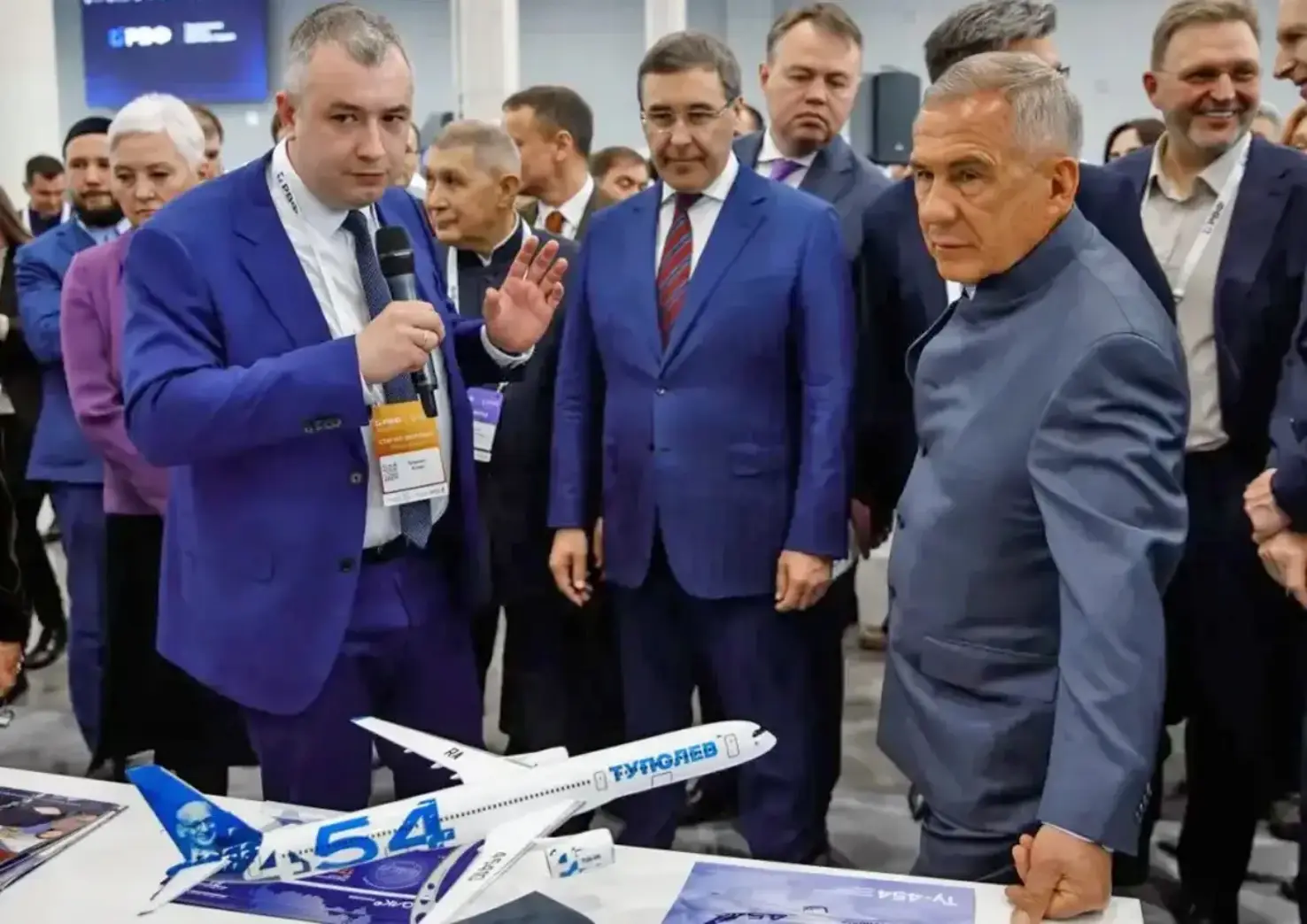
At a time when global aviation is increasingly shaped by geopolitical divides, Russia has taken another step toward reshaping its own future in the skies. At the 20th Russian Venture Forum in Kazan, United Aircraft Company’s Tupolev division unveiled the Tu-454 – a proposed long-range civilian aircraft designed to rival some of the most advanced Western jets.
The announcement signals more than just a new aircraft concept. It reflects a broader national push to reduce reliance on foreign manufacturers and build a self-sufficient aviation industry under mounting international sanctions.
According to Tupolev’s official communication channels, the project drew attention from high-level officials during the event. Among those visiting the stand were Minister of Science and Higher Education Valery Falkov and presidential aide Andrei Fursenko. The design was also presented to Rustam Minnikhanov, head of the Republic of Tatarstan, by Kirill Aseev, Tupolev’s deputy chief designer.
While technical details about the Tu-454 remain limited, early indications suggest it is intended as a direct competitor to long-haul widebody aircraft such as the Boeing 787 Dreamliner and Airbus A350. These models currently dominate international routes, making Tupolev’s ambitions particularly notable given Russia’s recent isolation from Western aerospace supply chains.
The unveiling comes against the backdrop of a long and often turbulent effort to modernize Russia’s civilian aircraft industry. Over the past decade, several programs have aimed to replace Western-built aircraft with domestically produced alternatives, often with mixed results.
Among the most prominent is the Irkut MC-21, a narrow-body jet designed to compete with the Airbus A320 and Boeing 737 families. Initially praised for its modern design and composite wings, the program faced major setbacks after sanctions cut access to foreign components, forcing a redesign around Russian-made systems and engines. Its entry into service has been repeatedly delayed.
Similarly, the Sukhoi Superjet 100, Russia’s first post-Soviet commercial aircraft, saw limited international success but struggled with reliability issues and heavy dependence on Western parts. A newer version, the Superjet New, is being developed with fully domestic components, though timelines remain uncertain.
Tupolev’s own legacy programs also highlight the challenges. The Tu-204 and its upgraded variant, the Tu-214, were intended to form the backbone of Russia’s medium-haul fleet. However, production remained low for years due to weak demand and competition from more efficient Western aircraft. Only recently have these models gained renewed attention as sanctions forced airlines to look inward.
The Tu-214 program, in particular, has become a cornerstone of Russia’s short-term aviation strategy. Although it was expected to deliver new aircraft in 2024, delays have pushed timelines back, with testing still ongoing. Even so, progress has been made – late last year, a fully import-substituted version received type certification, marking a key milestone.
Momentum increased further in February when the S7 Group signed a memorandum of cooperation to order 100 Tu-214 aircraft, signaling renewed confidence in domestic production.
Beyond new builds, Russia has also turned to extending the life of older aircraft. Efforts are underway to restore and maintain legacy models such as the Tu-204, first introduced in 1999, as airlines adapt to limited access to spare parts and new imports.
Within this broader context, the Tu-454 represents a more ambitious leap – an attempt to move beyond short- and medium-haul recovery efforts and re-enter the long-haul market with a competitive, homegrown design.