

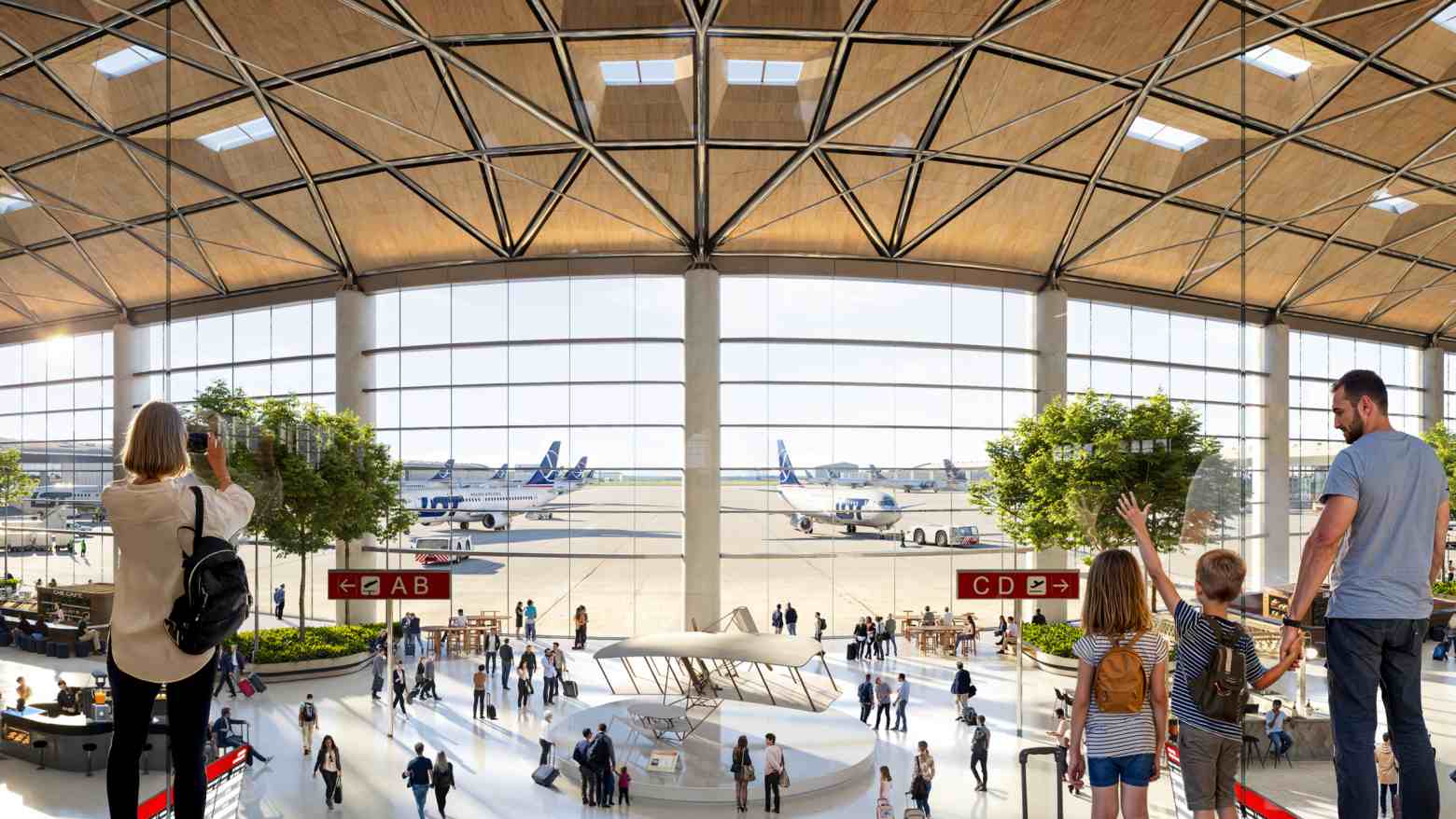
Poland’s most ambitious infrastructure project in decades is steadily moving from blueprint to reality. The Central Communication Port (CPK) has now received the finalized design for its flagship passenger terminal and railway station, bringing the mega-hub one step closer to its anticipated opening before the end of 2032.
The master architect’s design, developed by a British-led consortium featuring Foster + Partners and Buro Happold, along with over 30 international and Polish subcontractors, was recently accepted following a positive review by the Provincial Fire Service. The extensive documentation includes plans not only for the terminal and train station, but also for a bus station — a key part of the project’s goal to seamlessly integrate air, rail, and bus transport.

A Terminal for the Future
At nearly 450,000 square meters, the new terminal will be almost three times the size of Warsaw Chopin Airport’s passenger area. Designed to handle up to 11,000 passengers per hour in its initial phase, the CPK terminal will offer three distinct passenger levels:
Level +2: Check-in, security, Schengen area arrivals and departures.
Level +1: Non-Schengen travel, passport control, transfer facilities.
Level 0: Baggage claim and exits to long-distance bus services.
From day one, nearly 140 check-in desks will greet passengers, with room for an additional check-in island expanding that number to 170. The design anticipates a passenger mix where 35–40% will be transfer travelers connecting through CPK.
Smart Phasing, Big Capacity
CPK’s construction is being executed in phases — initially targeting 34 million annual passengers, with room to scale up to 44 million as demand grows. A modular approach allows for future expansions without major disruptions. Early work will focus on piers B, C, and D, accommodating both long-haul and Schengen-area flights, with piers A, E, and F reserved for later stages as traffic forecasts evolve.
The airport will launch with up to 67 aircraft stands equipped with passenger boarding bridges, including 23 for wide-body aircraft and 18 flexible MARS stands that can switch between wide-body or two narrow-body jets — a major upgrade compared to Chopin Airport’s current capacity.
A Rail and Bus Hub – Not Just an Airport
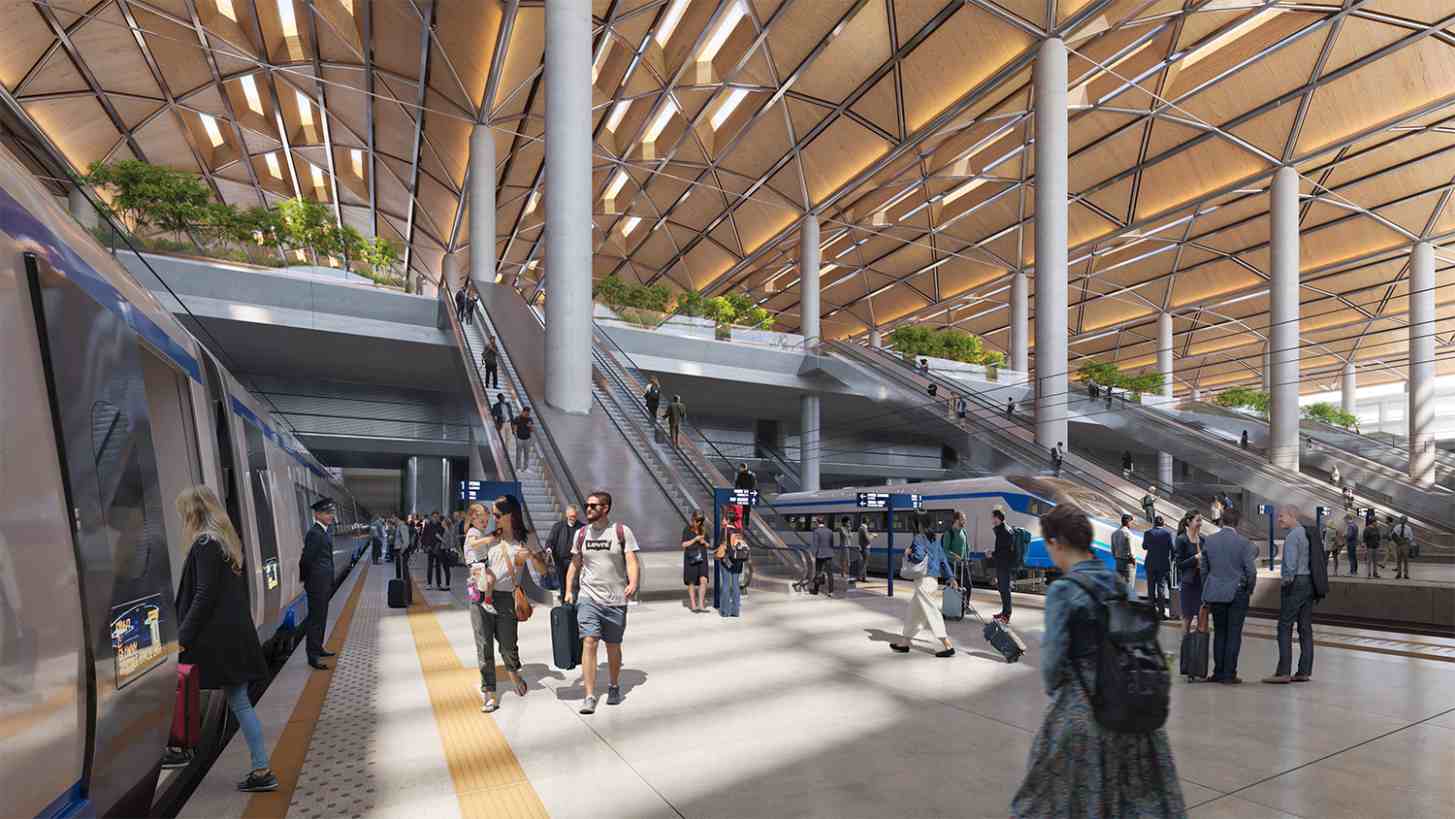
Unlike traditional airports, CPK is envisioned as a multimodal transport hub, where up to 50% of passengers will arrive by train or bus. A directly connected underground railway station and modular long-distance bus terminal have been integrated into the master plan, designed for smooth transfers and scalable growth.
Work on the underground railway terminal and tunnel is scheduled for completion by 2029, in parallel with the first phase of the Warsaw–Łódź High-Speed Rail line. The CPK terminal will serve as a major node in this future high-speed network.
From Vision to Construction
The project, coordinated with precision across various disciplines, also includes separate ongoing design work for runways, taxiways, service roads, and critical support facilities such as the Air Operations Control Center (AOCC), air traffic control tower, airport fire department, and meteorological stations.
Following a location decision issued in January, CPK is now preparing to submit final building permit applications to the Mazovian Voivode. Meanwhile, demolition work and land acquisition continue — over 2,100 plots and 2,000 hectares have already been secured through the Voluntary Acquisition Program (VAP).
With competitive tenders underway — including one for the general contractor and another for the baggage handling system — CPK is ramping up procurement. In total, PLN 30 billion (about USD 7.5 billion) in tenders are expected to be announced this year.
What’s Next?
Construction on the CPK terminal is scheduled to begin in 2026 with deep foundation work. Once complete, the airport will serve not just as a transit hub, but as a symbol of Poland’s role as a regional connector — linking Eastern and Western Europe, and integrating multiple forms of travel into one central port.
For travelers, the countdown begins now — and the next decade may well transform how Poland and its neighbors experience mobility.
Photo Source: CPK, Foster + Partners
